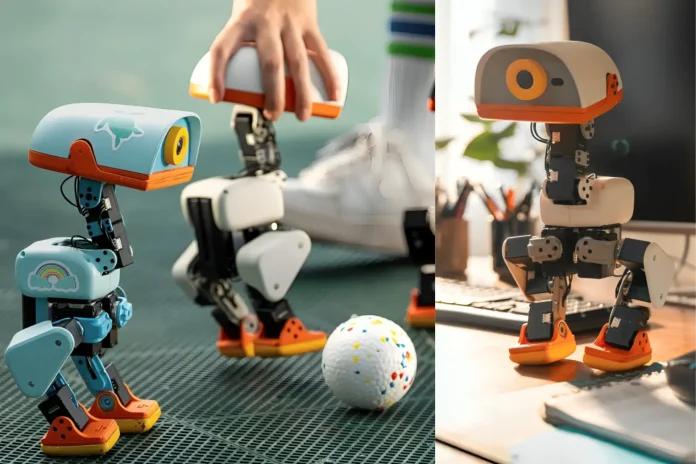
A $399 robot duck that waddles, picks things up with its beak, and learns new tricks through trial and error just hit the market and early demand is already forcing delivery delays.
Hugging Face and its robotics team at Pollen Robotics unveiled Microduck on August 27, 2026. The bipedal bot stands about 10 inches tall, weighs under 2 pounds, packs 15 motors, a camera, LiDAR, and motion sensors, and opens for pre-order at $399 before taxes and shipping. First deliveries were targeted before Christmas, according to the official product page and press materials from Pollen Robotics.
Out of the box it ships with seven trained behaviors waddling, sitting and standing, kicking, grabbing small objects with its articulated beak, recovering from common falls, and roller-skating once you add the optional accessory pack. It can follow a laser pointer, respond to the included game controller, and make unique creature-like sounds. Hugging Face CEO Clément Delangue called it “an open-source robot you can teach new tricks with reinforcement learning” and framed the design philosophy as “made to move, ready to fall.”
Reinforcement learning here means a straightforward trial-and-error process. Developers train behaviors inside a physics simulation, then transfer the finished policy to the physical robot. The software stack SDK, simulator, and training tools is open source under an Apache 2.0 license and available on GitHub. The mechanical and electronic hardware designs are not open source.
“Household Robot” should be used with caution. Microduck is able to grasp light objects like a sock or a pen, but it is neither a vacuum nor a butler; it is not intended for cleaning or other household chores. Axios pointed out that it is
“small in size, so you cannot expect it to perform many household tasks.”
Its true function is to provide an affordable platform for experimentation with physical AI.
Battery life runs roughly one hour on the removable 2600 mAh cell, depending on use. Optional packs add roller skates, a laser pointer, extra batteries, or spare parts. Company co-founder Thomas Wolf reported more than $2.6 million in pre-orders within the first 24 hours figures that come from the company itself and have not been independently audited. A backlog banner later appeared, shifting newer orders to an estimated four-to-six-month wait.
Microduck is a real $399 programmable robot whose reinforcement-learning tools work as described. Calling it a full-fledged household robot without spelling out its severe size and capability limits would mislead readers. It is best understood as a playful, approachable testbed for physical AI not a home servant.