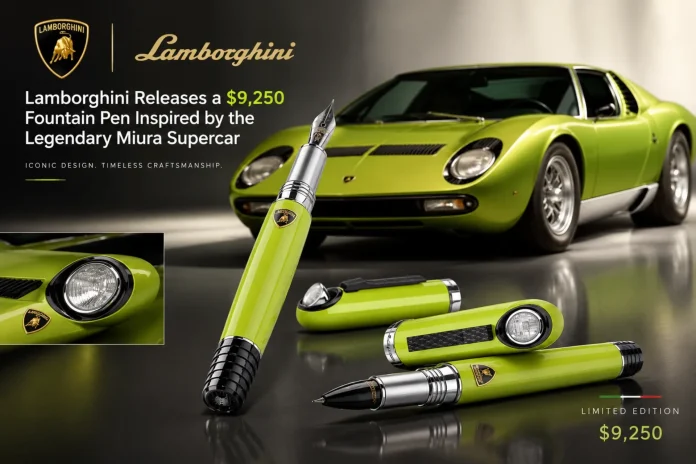
Italian pen company Montegrappa and Automobili Lamborghini have teamed up on something that only exists because someone, somewhere, asked the question: what if the most famous headlights in car history also lived on a fountain pen?
The result is the Automobili Lamborghini Miura collection, a limited run of writing instruments made to mark the 60th anniversary of the car that basically invented the modern supercar. The fountain pen version runs €8,250 — about $9,250 — and the whole point of it is the tiny rock-crystal headlight built into the cap. Press a button and it tilts up, just like the real thing used to do on the 1966 Miura. It doesn’t light anything. It just moves. That’s the flex.
Designed by Marcello Gandini at Bertone and unveiled at the 1966 Geneva Motor Show, the Miura is widely credited as the world’s first true production supercar: a low-slung, mid-engine machine with a transversely mounted V12 that redefined what a road car could look and feel like. Its signature front end—metal eyelids framed by black slatted “eyelashes” that flipped open to reveal the headlights—became one of the most recognizable faces in automotive design. Only about 763 Miuras were built between 1966 and 1973. Today, well-sorted examples routinely change hands for $1.5 million to more than $6 million.
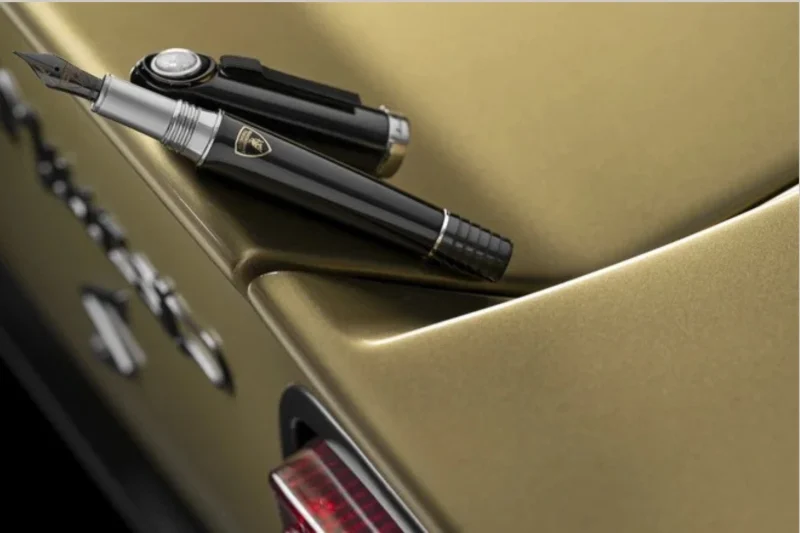
Montegrappa, Italy’s oldest pen manufacturer, translated those details into a far smaller object. The pen’s cap carries a domed piece of rock crystal (natural clear quartz) mounted on an engraved base that recreates the texture of the original lamp. A tactile push-button mechanism tilts the crystal upward out of its dark-rimmed housing, recreating the car’s motion. It does not light up; the effect is purely mechanical and visual. With the cap seated, the crystal sits at the top of the pen like a finial. Other cues include a black ribbed clip and cap band that echo the Miura’s slats, an end cap shaped after the engine’s louvered “Venetian grille,” and an aluminum barrel finished in three colors drawn from the car’s original palette: Giallo Fly yellow, Verde Miura green, and black.
The fountain pen measures 161 mm long and 20 mm in diameter and weighs 87 grams. It carries a ruthenium-plated 18K gold nib engraved with the Lamborghini shield, paired with an ebonite feed. Buyers can choose from extra-fine, fine, medium, broad, or 1.1 mm stub nibs. Filling is by cartridge or converter; two cartridges and a converter are included. A matching rollerball version costs €6,850, weighs 92 grams, and uses standard refills while retaining the same body, cap, and moving headlight. Both arrive in a lacquered wood and leather presentation case inspired by the Miura’s interior.
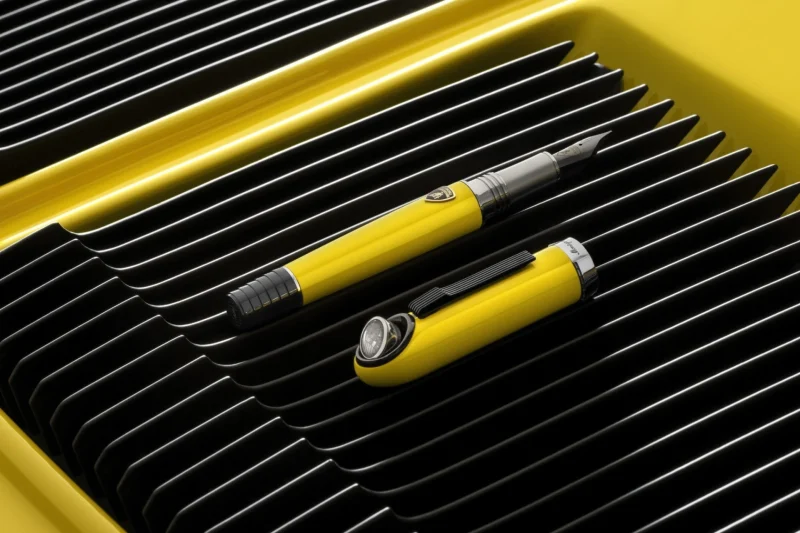
Production is tightly limited. Montegrappa is making 60 fountain pens and 60 rollerballs in each of the three colors, for a total of 360 pieces worldwide. Pre-orders are open on the company’s website, with deliveries expected to begin in mid-November 2026. The collaboration is the second between the two Italian houses. In 2023 they released the Automobili Lamborghini 60° collection to mark Lamborghini’s own anniversary; those hexagonal pens featured a red flip-switch modeled on the car’s start-button guard and sold for roughly $5,500 to $6,500.
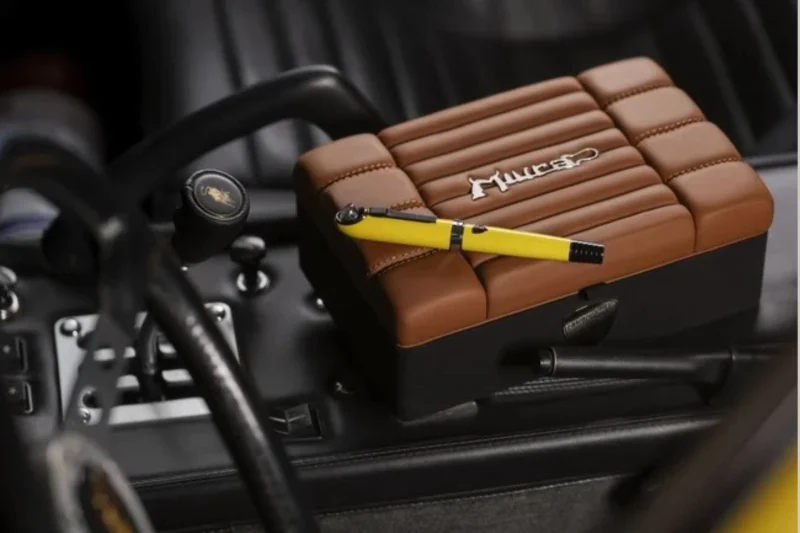
Whether the new pen is worth nearly $9,300 is a matter of taste and means. Montegrappa has long produced high-end instruments using materials that range from precious metals to, on occasion, ethically sourced woolly mammoth ivory. The Miura edition’s appeal rests less on writing performance—an 18K gold nib is standard at this level—than on the fidelity of the translation and the scarcity of the object. For collectors who already own (or aspire to own) the car, it is a wearable, pocketable fragment of the same design language. For everyone else, it is an expensive, precisely engineered curiosity whose main job is to let its owner raise and lower a tiny crystal headlight whenever the urge strikes.
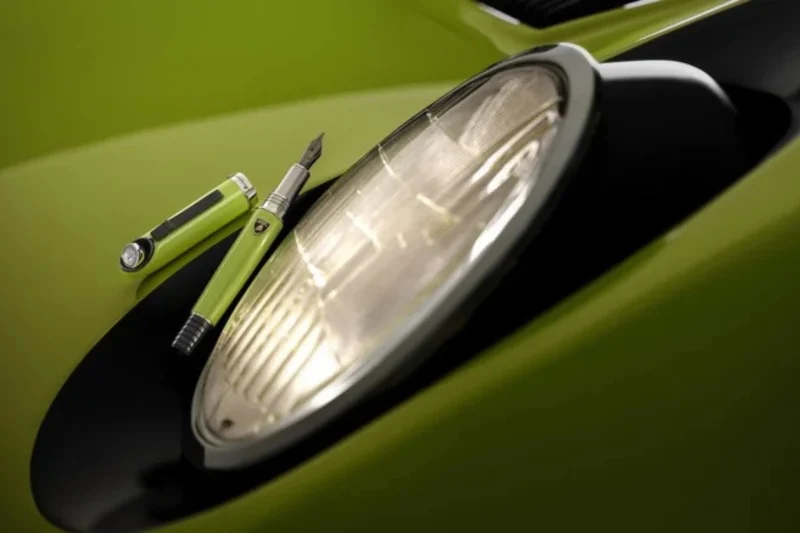
The real Miura remains the rarer and more expensive proposition. The pen simply makes one of its most memorable mechanical flourishes available at a scale that fits in a hand rather than a garage.