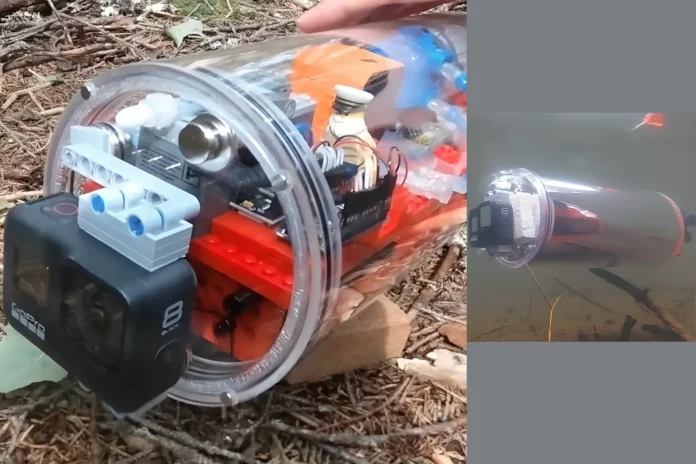
A Finnish YouTuber just dropped a radio-controlled submarine that actually dives, holds depth, tilts its nose, and powers through a river current and a big chunk of it runs on LEGO Technic. Brick Experiment Channel’s Submarine 5.0, uploaded September 5, 2026, is already circulating hard after Dexerto covered it two days later. The little 2.95 kg craft hit about 1.5 meters (4.9 feet) underwater in real river conditions while the creator filmed the whole run with an onboard GoPro.
This is the fifth version in a multi-year series. Earlier builds used lemonade pitchers or glass containers and syringe-style ballast. Version 5.0 keeps the LEGO motors and linkages but pairs them with a sealed acrylic hull measuring 250 × 120 mm, a rounded plastic nose for better flow, an Arduino Nano ESP32 brain, a Honeywell pressure sensor, and an MPU-6050 gyroscope/accelerometer.
Depth control comes from a modified Kamoer NKP peristaltic pump that fills and empties a flexible 50 ml veterinary IV bag. Pump water in and the sub gets heavier, sinks. Pump it out and buoyancy rises. The creator reports the system stayed completely dry through roughly 10 hours of underwater testing. Pitch control is handled by a 400-gram stack of steel washer plates that slides forward or backward on a LEGO linear actuator. Shifting that mass moves the center of gravity, tilting the nose up or down by about ±13 degrees. Combine the tilt with forward thrust and the sub dives or climbs faster than ballast alone can manage.
Propulsion uses two non-LEGO 55 mm propellers driven through magnetic couplings so no shafts pierce the hull. Three LEGO M-motors and one XL-motor handle the rest. Power comes from a standard LEGO 9V rechargeable battery box. The whole package is radio-controlled on 40 MHz and carries a LEGO minifigure “captain” for the photos.
Headlines calling it an “all-LEGO submarine” stretch the truth. The pressure hull is acrylic, the sensors and pump are commercial, the propellers and tungsten ballast (1.35 kg fixed) are off-the-shelf, and the magnets are neodymium. LEGO Technic supplies the motors, structural links, linear actuator, and a surprising amount of the mechanical layout. Accurate description: a LEGO-heavy, fully working RC model submarine.
This project demonstrates just how far an ingenious combination of plastic building blocks, open source hardware, and careful iteration can go. It was never intended to be anything other than what it is: a small but dependable robot which can swim, navigate, and return safely to the surface as proof that serious underwater engineering does not require a clean room.