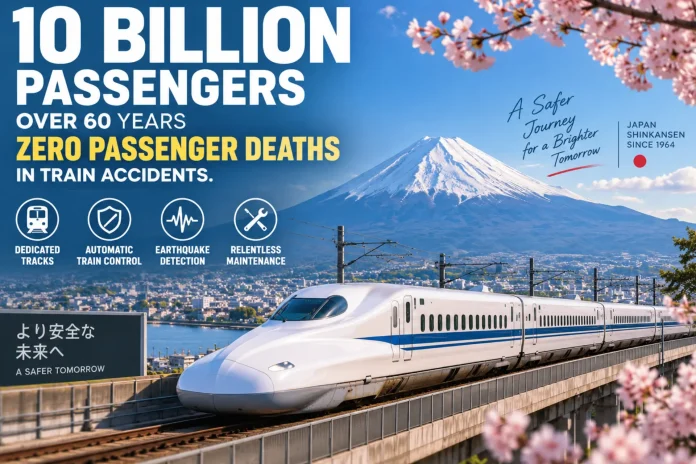
The bullet trains in Japan have been transporting over 10 billion people at fast speeds since 1964. There hasn’t been a single person killed in a train accident like derailments.
This is basically the essence of a viral statement that can be found in various places on the Internet, even in a Pubity post where the picture of a train passing Mount Fuji is linked with the impressive fatality statistic.
Authoritative sources line up on the key facts. Japan’s Ministry of Land, Infrastructure, Transport and Tourism has long reported zero passenger fatalities on the Shinkansen since operations began on October 1, 1964. Wikipedia and multiple rail analyses state that the network has carried over 10 billion passengers with no passenger deaths from derailments or collisions. JR Central reports roughly 7 billion passengers on the Tokaido line alone and “no accidents resulting in fatalities or injuries of passengers on board.”
The distinction matters. The perfect record covers operational train accidents. It does not mean nobody has ever died or been hurt anywhere near a Shinkansen. Suicides, trespassers, and rare door-related incidents have occurred. Wikipedia notes injuries and a single fatality from doors closing on passengers or belongings, plus suicides by people jumping from or in front of trains. Those are tracked separately from train accidents.
The Shinkansen train runs on the special tracks that have been built for this purpose only. Level crossings are not there, nor does it share the track with any freight train. The Automatic Train Control system is used to monitor the exact position and speed of the trains, which are controlled by this system.
Japan’s earthquake systems add another layer. Sensors detect the faster P-waves and trigger power cutoffs and emergency braking, often before the stronger shaking arrives. Maintenance is relentless: specialized “Doctor Yellow” diagnostic trains inspect tracks and overhead wires at high speed, and operators will slow or suspend service for weather rather than push through risk.
On October 23, 2004, a magnitude 6.8 earthquake hit Niigata. The Joetsu Shinkansen train Toki 325, carrying about 154–155 people and traveling near 200 km/h, derailed. Eight of its ten cars left the rails. The train stayed largely upright, did not overturn or fall from the structure, and stopped without a secondary collision. No passengers or crew were killed or injured. It remains the most significant operational derailment in Shinkansen history, and it still produced a zero-casualty outcome. Further anti-derailment measures followed.
High-speed rail elsewhere has not matched this. The 1998 Eschede ICE disaster in Germany killed 101. The 2013 Santiago de Compostela derailment in Spain killed 79. The 2011 Wenzhou collision in China killed about 40. Japan’s combination of separated tracks, automatic control, seismic protection, and safety-first culture has kept its passenger accident death toll at zero across more than six decades and 10 billion journeys.