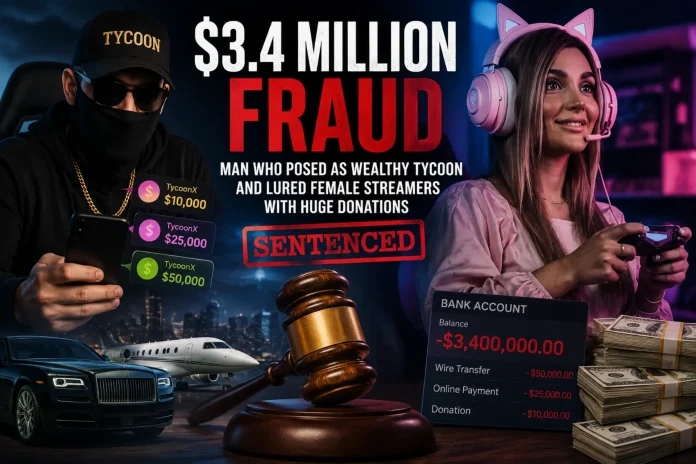
A South Korean man in his 30s who posed as a wealthy tycoon to win the trust of female internet streamers has been sentenced to seven years in prison for defrauding victims of about 4.8 billion won, or roughly $3.4 million, according to Dexerto’s reporting on the Suwon High Court sentencing.
The Suwon High Court’s first criminal division, led by Chief Judge Shin Hyun-il, handed down the combined sentence on August 15. The defendant, identified only as A under South Korean privacy rules, had earlier received separate four-year and three-year terms in lower-court trials on two related fraud cases, as Yonhap reported on a prior Suwon District Court sentencing of a creator convicted of extortion. The appeals court merged the cases into one seven-year prison term.
Prosecutors charged A with violating the Act on the Aggravated Punishment of Specific Economic Crimes through fraud, per Lexology’s analysis of South Korea’s money-laundering offence framework. Court records show the scheme ran from August 2023 to May 2025. Victims included female broadcasters known as BJs and gift-certificate dealers.
A built credibility on streaming platforms by sending large numbers of paid virtual gifts called Star Balloons. Once established as a major donor, he arranged in-person meetings and presented himself as a successful investor, school foundation operator, company owner, and angel investor. According to court findings, he told some streamers he could convert “black money into white money” and offered weekly interest of 7 to 11 percent if they loaned him cash. In one documented case he obtained 510 million won from a single streamer under that pitch. He also promised to flood other broadcasters’ streams with donations to help them win competitions, then kept the money they advanced.
Gift-certificate dealers were approached with a different story. A claimed he would settle payment within one or two weeks if they first topped up balances or supplied cards on credit. Hundreds of millions of won in merchandise changed hands under those terms.
Investigators determined A had no regular income and carried more than 2 billion won in debt, much of it from failed cryptocurrency investments, as BitcoinWorld documented in a prior AfreecaTV BJ crypto-scam case. The money taken from victims went to gambling, further streamer donations, and a revolving effort to cover earlier debts — echoing another case where livestream donations bled into real-life financial collapse. The court described the conduct as highly reprehensible, noting A’s prior convictions for similar offenses and the fact that most victims recovered little or nothing.
In mitigation, judges weighed A’s full admission of the charges and the roughly 1 billion won he returned to some victims. They also observed that several victims had accepted promises of returns far above normal market rates. The final sentence reflects both the scale of the fraud and those limited mitigating factors.
Star Balloons function as convertible virtual gifts on major Korean streaming platforms. Large donors often gain direct access and personal rapport with popular female broadcasters. Court documents show A exploited that dynamic systematically, turning online generosity into offline loans that were never repaid. The danger is not hypothetical: see the killing of Korean streamer Yoon Ji-ah by a top donor she tried to cut ties with for a fatal example of the same pattern. The case remains one of the larger documented streamer-related frauds of recent years in South Korea, and fits within the scale of online-scam losses tracked in 2025 across the broader digital economy.
Read Also: a $4 billion crypto-fraud case where the woman behind the scheme vanished