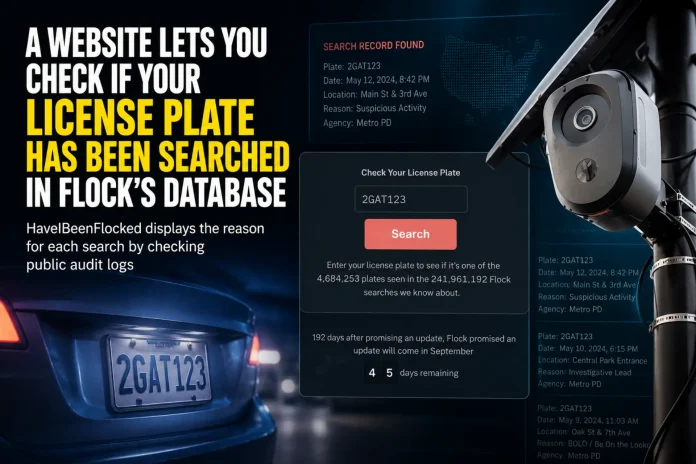
A new public website now lets anyone enter a license plate number and see whether it has been manually searched inside Flock Safety’s nationwide automated license plate reader network, complete with the stated reason logged for each query.
HaveIBeenFlocked.com aggregates audit logs released by local governments through transparency portals and public records requests. The database currently holds records of more than 241 million searches covering more than 4.6 million plates, per Newsweek’s coverage of the launch drawn from thousands of agencies. A match shows that an operator using the Flock system queried that plate, the agency involved when available, the date and time of the search, and the reason the operator entered. It does not show whether a vehicle simply drove past one of the cameras.
Flock Safety, an Atlanta-based company, operates a network of more than 120,000 cameras and connected devices across 49 states. The cameras photograph vehicles, capture license plates, make, model, color and other visible features, and store the data for later search by participating law enforcement agencies and some private customers. Operators can run targeted plate lookups, broader geographic history searches, visual similarity matches, and convoy-style pattern analysis that identifies vehicles frequently traveling together.
The site’s operators stress that a search result does not mean the driver was stopped, investigated, or accused of any crime. Search policies differ by jurisdiction, and many agencies do not require a warrant or even reasonable suspicion before querying the database. Operators are not always sworn police officers. The logs themselves are often incomplete or redacted; full officer names appear mainly in organizational audit logs, while public transparency portals frequently replace them with UUIDs or truncated identifiers.
H.C. van Pelt, the independent developer who built and maintains the project under the Footnote4a banner, created the tool to make already-public records searchable for ordinary people. He has described the effort as a way to expose the scale of routine lookups and to give residents a practical method of auditing how the system is used. The project is fiscally sponsored by the Alternative Newsweekly Foundation, a 501(c)(3) nonprofit, and operates without institutional backers that could dictate content. Van Pelt has said Flock previously attempted to pressure web hosts to take the site offline, arguing that publishing the logs threatened public safety and officer security. Those efforts did not succeed in removing the data.
The audit logs arrive through two main channels. Some agencies publish heavily redacted “public search audit” files on Flock-hosted transparency portals. Others respond to formal public records requests with more complete organizational or network audit exports that include operator names, case numbers, filters applied, and free-text reasons. Volunteers and researchers have filed hundreds of such requests; the site accepts additional logs submitted by the public and processes them into a searchable form after redacting personal addresses and other sensitive details that occasionally appear in the reason fields.
Common reasons recorded in the available data include drugs, motor vehicle theft, burglary, and various forms of “investigation.” Some entries reference welfare checks, “stranger danger,” campus suspicious persons, or immigration-related keywords. A portion of searches carry no documented reason at all. The site also tracks searches whose free-text fields mention protests, religious gatherings, journalists, or political activity, and it publishes separate reports on immigration-related queries and camera density by county drawn from independent mapping efforts.
The launch of the searchable tool coincides with a broader wave of scrutiny. More than 50 communities have canceled, suspended, or rejected Flock contracts or deactivated cameras in 2026. Privacy advocates and some local officials have cited concerns over data sharing with federal immigration authorities — a fear echoed in the deadly ICE operation that drew federal-scrutiny questions in Georgia, the volume of non-criminal lookups, and documented cases of officers misusing the system to track romantic partners or acquaintances — one in a wider pattern of surveillance-captured misconduct exposing accountability gaps. In one Milwaukee investigation, victims learned of alleged misconduct only after searching their own plates on the site.
In mid-August 2026, Flock Safety announced a package of policy changes. The company is recommending a default data retention period of seven days instead of 30, a retention trim that follows recent federal-data minimization pushes, introducing an “Evidence Mode” that lets detectives preserve specific plate data tied to an active case, as the Chicago Tribune reported, requiring case codes for searches, making its audit-assistance tool mandatory for law enforcement customers, and adding automatic lockouts for users whose activity triggers abnormal-pattern flags. Agencies will also gain finer control over which offense types outside agencies may search against their cameras. Existing customers retain the ability to keep longer retention periods if their local policies require it.
The site itself does not store the license plate numbers that visitors enter. The query is processed and the input is discarded. Results remain limited by the incomplete nature of the source material: many agencies still refuse or heavily redact the logs, and coverage varies widely by jurisdiction. Users who find a match can review the available details and, if desired, file their own follow-up records requests using templates the site provides. Those who obtain new logs are invited to submit them so the public database continues to grow.
For drivers wondering whether their plate has been the subject of a deliberate query inside one of the country’s largest private surveillance networks, the answer is now a few keystrokes away. The deeper questions about how often those queries occur, under what standards, and with what oversight remain matters for local governments, state legislatures, and the courts.