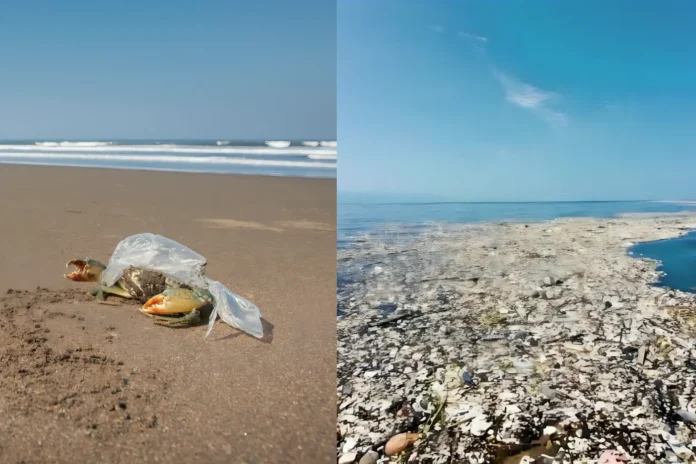
It happened that the researchers who were retrieving marine litter from the Great Pacific Garbage Patch found it quite incredible to see how the plastic garbage was no longer simply litter. They became new settlements for a variety of marine organisms.
Anemones clung to bottle caps, while barnacles and even crabs made their way through old fishing gear. The amphipods and hydroids colonized plastic garbage pieces that should not have been at all in those waters.
This is neither fake nor a sensational story that has been blown up into a myth. On the contrary, it was confirmed by a study published in 2023 in Nature Ecology & Evolution. Researchers examined 105 pieces of floating plastic and found marine organisms turning our garbage into floating real estate. In total, they identified 46 different invertebrate species around 484 individual animals.
What really surprised them was that 37 of those species were coastal creatures, many originating from waters near Japan. These coastal species showed up on more than 70% of the plastic pieces they pulled up. Even more remarkable, the team found clear evidence of reproduction eggs, buds, juveniles, and multiple life stages all present on the debris.
A tweet from X.
The researchers concluded that the plastic in the North Pacific Subtropical Gyre has essentially created a brand-new ecosystem what they’re calling a “neopelagic community.” In simple terms, our pollution has built persistent floating islands that allow coastal species to survive and reproduce hundreds or even thousands of miles from shore, in waters where they never used to live.
This builds on what we saw after the 2011 Japan tsunami, when debris swept out to sea carried living things across the Pacific. But this is different. It’s not a one-off event. Plastic lasts for decades out there. It drifts slowly, giving life plenty of time to colonize, settle in, and start breeding.
Out here, folks on the internet act like clockwork. Amazed by how life bends without breaking, some stare wide eyed at nature’s stubborn pulse. Meanwhile, unease creeps through others foreign critters tagging along could tear apart shorelines once they land. Now comes a twist: what happens when animals rely on that floating junk? Pull it out anyway? That question lingers.
Out there, waves carry trash just like the Ocean Cleanup folks keep finding. Not hard to miss what’s happening creatures get caught, blocked up, poisoned by plastic bits. Some animals try adapting anyway.
At the end of the day, this discovery feels unsettling. Nature is adapting to our mess in real time. Coastal animals are thriving in the open ocean because we accidentally gave them highways of plastic to live on. But let’s be clear: this isn’t the ocean “healing itself” or pollution being a good thing. It’s proof that we’ve altered the marine environment so drastically that life is being forced to improvise with our garbage.
The Great Pacific Garbage Patch used to be just a symbol of human carelessness. Now it’s something more complicated an accidental, drifting ecosystem built from our waste. Cleaning it up isn’t just about removing plastic anymore. It’s about facing how deeply we’ve changed the oceans, and what that really means.