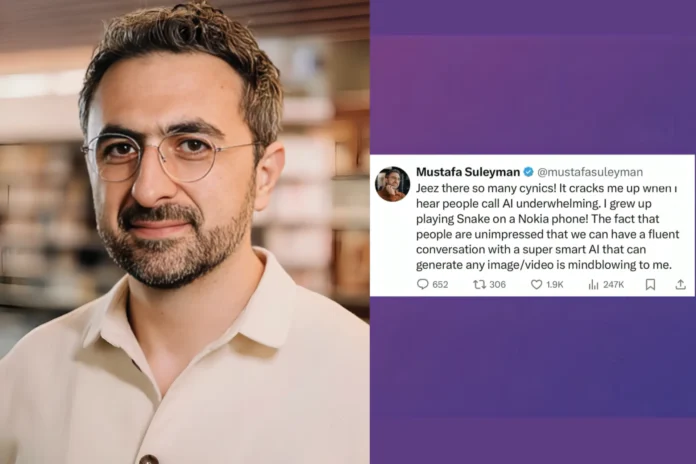
Microsoft’s AI boss Mustafa Suleyman is genuinely baffled that millions of Windows users think Copilot and the company’s other AI tools are underwhelming. On 19 November 2025 he posted on X:
“Jeez there so many cynics! It cracks me up when I hear people call AI underwhelming. I grew up playing Snake on a Nokia phone! The fact that people are unimpressed that we can have a fluent conversation with a super smart AI that can generate any image/video is mindblowing to me.”
The post blew up after the pop-culture account PopBase reposted a screenshot the next day. Within hours it had 1,982 likes, 225 replies and more than 251,000 views. Most of the replies were brutal.
A tweet from X.
For many people in the US, UK, Canada, Australia and New Zealand, Windows is simply the computer they use every day – at school, at work, at home. When Microsoft started pushing Copilot into the taskbar, Start menu and even basic file searches, a lot of users felt the AI was being forced on them whether they wanted it or not.
Copilot regularly “hallucinates” wrong answers or gives convoluted instructions for simple tasks (Windows Central documented a promotional video in which Copilot failed to explain how to change text size in Settings).
The tool routes searches through the cloud, raising privacy worries especially in countries with strong data-protection laws.
Battery life and performance take a hit on older laptops, a real issue for students and remote workers.
Many see the features as intrusive bloatware rather than helpful additions. One widely liked reply summed it up:
“No one is asking for this. We just want a stable operating system.”
The tweet landed days after Microsoft’s Ignite 2025 conference, where Windows chief Pavan Davuluri described the future of Windows as an “agentic OS” one where AI agents act on your behalf across devices and the cloud. The phrase alarmed users who already felt they were losing control, and Davuluri ended up turning off replies on his own post because of the volume of criticism.
The PopBase summary and screenshot accurately reflect Suleyman’s original post, as confirmed by reporting from Windows Central, The Verge and Times of India. Complaints about bugs, hallucinations and forced integration are also well-documented in user forums and independent reviews, not just anecdotal.
The episode highlights a growing trust gap between Silicon Valley executives and everyday users. Microsoft’s internal data reportedly shows strong enterprise adoption and productivity gains, but consumer sentiment on forums and social media is far more negative. People aren’t necessarily against AI in principle they’re against AI that feels half-baked, hard to turn off, and prioritised over basic stability.
Suleyman, who co-founded DeepMind and wrote the book The Coming Wave, has spent years arguing AI should be built with humanist values. Yet when he compares today’s tools to Snake on a 1990s Nokia, many users hear only that their real-world frustrations are being dismissed as cynicism.
As Windows approaches its 40th birthday, the company faces a familiar challenge: how to add powerful new technology without alienating the hundreds of millions who just want their PC to work reliably. So far, the backlash suggests Microsoft still hasn’t found the right balance.