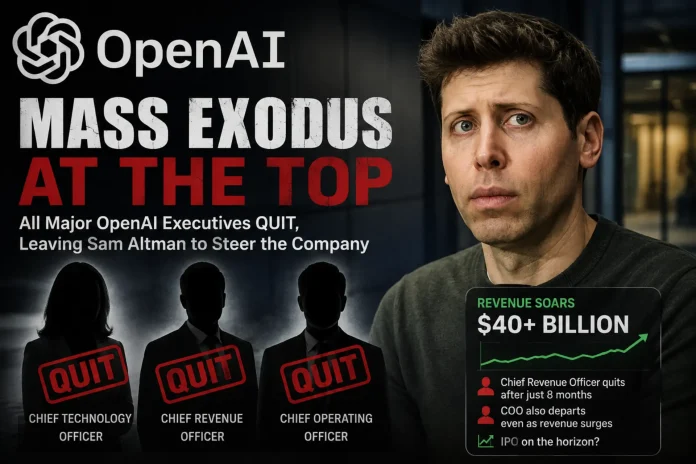
OpenAI’s annualized revenue run rate has topped $40 billion even as a string of senior executives depart, leaving CEO Sam Altman to guide the company through its next phase ahead of a potential IPO.
Chief Revenue Officer Denise Dresser is leaving after roughly eight months in the role. She joined in December 2025 from her position as CEO of Slack, where she had previously spent more than a decade rising through Salesforce’s enterprise sales ranks. OpenAI announced that Dali Rajic, most recently president and chief operating officer of the cybersecurity firm Wiz, will take over the revenue organization. Dresser said in a LinkedIn note that she made the difficult decision to pursue other opportunities and will remain through a short transition period.
Her exit lands just days after longtime executive Brad Lightcap announced he was departing. Lightcap joined OpenAI in 2018 after working with Altman at Y Combinator. He served as chief financial officer and then as chief operating officer from 2022 until earlier this year, when he shifted to a special projects role. In a message shared publicly on X, Lightcap called the decision bittersweet and said mission success now feels within sight, as reported by TechCrunch. He plans to start something new while continuing to support the company’s goals from outside.
The commercial and operating changes coincide with several departures from OpenAI’s safety and ethics leadership. Chloé Bakalar, who joined as AI ethics lead in August 2025 after serving as Meta’s chief ethicist, left in July without a public announcement or named replacement. People familiar with her work said she was the company’s only dedicated ethicist, focusing on ethical approaches to model development, human interaction with AI systems, and questions of machine consciousness. OpenAI stated that ethical considerations are embedded across research teams rather than residing with a single owner.
Johannes Heidecke, head of safety systems, also left in July following a reorganization that folded safety functions under research leadership. Heidecke had joined in 2021 and taken the safety systems role in 2024. Chief Research Officer Mark Chen told staff that safety teams would report to Mia Glaese in an expanded vice president of research and safety position, with Saachi Jain serving as interim head of safety systems.
Joshua Achiam, chief futurist and former head of the company’s mission alignment effort, notified colleagues in early July that he would depart after nearly nine years. Achiam, who joined as an intern in 2017, said in a staff note that he had been considering the move for some time and now saw a path to advance the broader mission from outside a frontier lab. His last day was July 24.
OpenAI’s revenue acceleration has been driven by growth in AI coding tools, consumer and enterprise subscriptions, and early advertising revenue. According to Bloomberg, company leaders have pointed to month-over-month gains exceeding 20 percent in July. Per TipRanks’ reporting, the company recently completed a large employee share buyback at an $852 billion valuation and has taken steps consistent with preparing for a public listing.
Altman and co-founder Greg Brockman have framed the leadership shifts as a pre-IPO refresh intended to position the organization for its next stage of scale. Brockman has assumed a more prominent operating role following other recent transitions. The company continues to report more than one billion weekly active users and more than two million business customers.
The pattern of senior exits from both commercial and safety functions has drawn attention as OpenAI navigates rapid model development cycles, enterprise expansion, and increasing external scrutiny of AI capabilities and controls. Those who have left have offered a range of explanations, from personal readiness for new work to the sense that the core mission can now be advanced from different vantage points.