

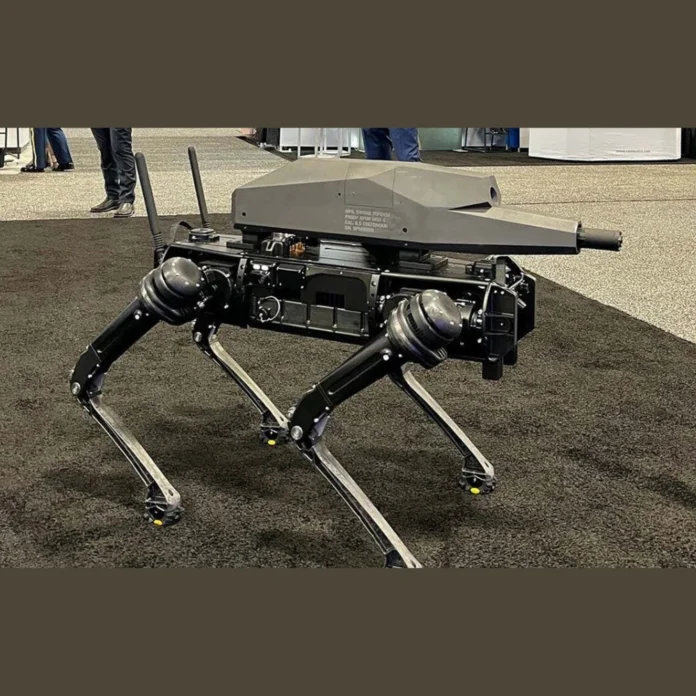
Hailing from China, Black Panther 2.0 is the most advanced robotic dog that has marked a breakthrough moment in robotics, running into the elite ’10-second club’ in a 100-meter dash. This robotic dog covers the distance faster than most humans and as fleetingly as many of nature’s fastest creatures; it has been hailed as a beacon in technological innovation and creativity.
Measuring 38 kilograms and a height of just 0.63 meters, this Black Panther 2.0 can run up to an astounding five strides every second. Its blazing speed, of course, simply cements Black Panther as part of robotics lore as among, if not, the fastest quadrupedal robots on earth. With all that speed, the robotic canine was able to complete the dashes of 100 meters in under ten seconds and had easily bested the previous world record set at 19.87 seconds by the HOUND created by engineers hailing from Korea’s.
The Black Panther 2.0 Robot draws inspiration in its design structure from two fascinating creations of Mother Nature: one is the panther, and another is the long-legged jerboa. The current robot uses various springs at joint positions of its knees and represents a state-of-the-art kind of shock absorbance, using high speeds comfortably. The carbon-fiber shins copied from the animal jerboa offer some 135 per cent more increase in stiffness; this has only occasioned a consequential weight increase in the structure of just a mere 16 per cent-that is, with gain in both sturdy and efficiency. By introducing claw-like ‘running shoes’ inspired by cheetah claws, improving the robot grip increased it by an unbelievable 200 per cent.
Black Panther 2.0 is unique in its advanced technological backbone. This robot utilizes A.I. and machine learning to make real-time adjustments in its gait for seamless performance on all types of terrain. The Huygens’ coupled pendulum principle refines the movement further as its limbs easily synchronize with each other to unify a motion. High-power-density motor drivers, custom-developed for this project, are able to deliver unparalleled strength and precision that will set the cornerstone for further industrial applications.
Behind this piece of engineering is a collaboration between Zhejiang University and the Hangzhou-based startup Mirror Me. Astonishingly, the prototype was developed in just three months with seamless integration of advanced software and components. According to Wang Hongtao, head of the project and a professor at Zhejiang University, the team overcame numerous challenges to deliver a fully functional robot in such a short time.
Black Panther 2.0’s achievement is more than a world record; it represents a leap in closing the gap between robotic and biological mobility. The eventual ambition of the team in future generations would be to exceed even the speediest of all land animals: cheetahs and ostriches. This very ambitious aspiration underlines the commitment toward finding the unexplored potentials in robotics.
