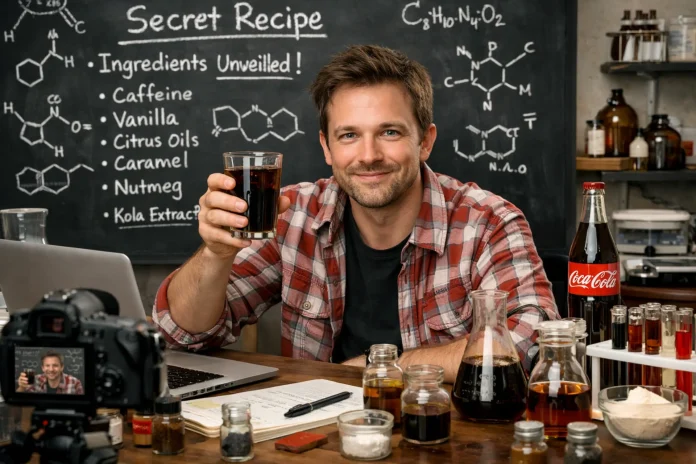
A science YouTuber known as LabCoatz has released a detailed claim of perfectly replicating Coca-Cola’s closely guarded secret formula after a year of intensive chemical analysis and experimentation. In a 25-minute video uploaded on January 8, 2026, he presents his homemade “Lab-Cola” as chemically and taste-identical to the commercial product, backed by mass spectrometry data and multiple blind taste tests. The video has garnered over 2.9 million views and 178,000 likes in just a few days, sparking viral conversations across social media about corporate secrecy and open-source science.
LabCoatz began by outlining Coca-Cola’s known base ingredients—sugar, caffeine, phosphoric acid, caramel color, and carbonated water—while focusing on the elusive “natural flavors” blend, historically referred to as Merchandise 7X. Collaborators Vince from the @Neptunium channel and Ben from @MassSpecEverything conducted gas chromatography-mass spectrometry on store-bought Coke samples, revealing trace compounds that LabCoatz matched against academic research papers. He then spent months iteratively refining two key mixtures: one alcohol-diluted oil blend dominated by lemon, lime, cassia cinnamon, nutmeg, and smaller amounts of orange, coriander, fenchol, and an unexpected tea tree oil for a distinctive note; the other a water-based solution incorporating caffeine, glycerin, vanilla extract, wine tannins for mouthfeel, vinegar, and phosphoric acid.
The process involved dissolving sugar into a syrup base, incorporating precise volumes of each mixture, heating gently to integrate flavors without loss, cooling, and finally carbonating with chilled sparkling water before a fridge rest to mellow the profile. LabCoatz emphasized breakthroughs, such as adding wine tannins and tea tree oil, after hundreds of trials failed to capture the exact complexity of Coke. Blind taste tests with participants, as shown in the video, repeatedly confirmed the absence of detectable differences, with side-by-side visuals of his custom-labeled bottles reinforcing the visual match.
Coca-Cola has maintained its formula as a trade secret for over a century, opting against patenting to prevent eventual public disclosure, and even displays a symbolic vault at its Atlanta museum. The company publicly lists major ingredients but guards exact proportions and sourcing details fiercely. Previous public recipes, such as one highlighted in a 2011 radio program, drew no legal challenges, supporting the legality of personal replication efforts like this one.
This project distinguishes itself through rigorous methodology and full transparency, as LabCoatz shared the complete recipe—with safety cautions about handling concentrated acids and oils—directly in his video materials. Online reactions blend fascination with tongue-in-cheek warnings about “disappearing” for challenging a corporate giant, while many applaud the democratizing power of modern lab tools. Yet the replica’s perfection remains the creator’s claim, unverified by Coca-Cola itself, which has issued no public response as of now.
Readers curious about the step-by-step demonstration can watch the full video on YouTube. The key research paper guiding compound identification is available through the American Chemical Society. Coca-Cola’s own history of formula protection is outlined on their official site. Anyone considering home experimentation should prioritize using food-grade materials and adhering to proper safety protocols, given the potent chemicals involved.