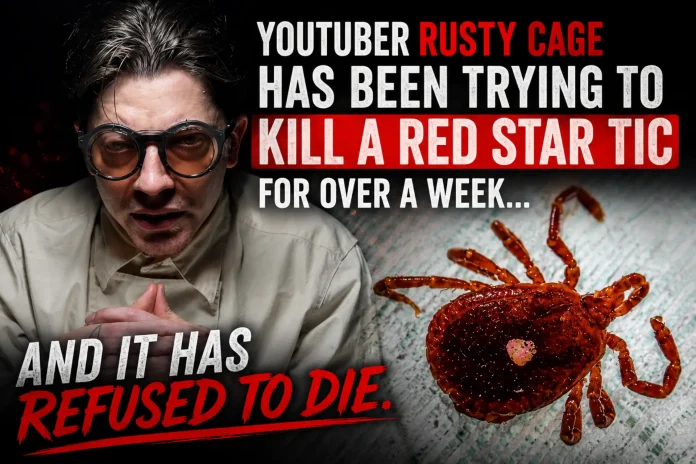
Florida YouTuber Rusty Cage has spent sixteen days testing the limits of a Lone Star tick he removed from his own body by submerging it in water for two weeks, freezing it for a full day, and repeatedly stimulating it, only for the arachnid to revive each time it appeared dead.
Cage encountered the tick attached to his skin and carefully extracted it before placing the specimen into a container of water to observe how long it might survive submersion. Over the following days he documented the process in short videos posted across TikTok, X, and other platforms, showing the tick continuing to move even after five days in water. By day seven it appeared motionless when left undisturbed, yet revived upon gentle prodding with tweezers, prompting him to continue the tests rather than end them.
His experiments progressed methodically, with the tick kept in water for approximately two weeks before transfer to a dry petri dish where excess liquid was removed. In his day sixteen update, Cage described the sequence directly, stating:
“It has been fifteen days since I began my experiments on the Lone Star Tick. After two weeks of floating in water, I was certain that it had finally perished. Once again, I transplanted the specimen into a dry petri dish, making sure to remove any excess liquids. Upon inspection, its limbs began to twist in what appeared to be a loss of hemolymph hydraulic pressure, the so-called death curl. Fool me twice, shame on me. Ticks respond strongly to carbon dioxide in order to detect a nearby host, and after blowing life back into the creature, it quickly began to recover. It walked once more amongst the living, for now at least, but I am quite certain that my next experiment will be the last. Ticks are notoriously known to be cold tolerant. However, I do not believe it will survive twenty-four hours in my freezer. But there is only one way to find out. On day sixteen I removed the specimen and, just as expected, no signs of life. But death is a gift that I have yet to present. Death is a gift that the tick has not earned. Death is a gift that can be revoked. I will keep you updated.”
The goal behind the tests appears rooted in personal curiosity after the initial encounter, combined with an interest in creating engaging short-form content that explores everyday biological resilience rather than any formal scientific protocol. Cage has framed the series as an informal experiment to observe how long the tick could endure common household conditions, testing widely held assumptions about killing ticks while turning the process into a running narrative for his audience. The project evolved from a one-off removal into daily updates that highlight the creature’s repeated recoveries after apparent death.
Scientific details help explain the tick’s continued survival. Lone Star ticks possess a tough exoskeleton and can close their spiracles, the breathing pores, to limit water intake and survive prolonged submersion, with studies on related ixodid species showing survival for up to fifteen days or more underwater through reduced metabolic activity and tolerance of low oxygen. Their slow metabolism allows extended periods without feeding, often weeks or months, while they enter states of quiescence or diapause under stress.
Cold tolerance varies by life stage and feeding status. Unfed adults show greater resistance to moderate freezing, though they remain freeze-intolerant at extreme prolonged low temperatures. Household freezers, around minus 18 degrees Celsius, may induce temporary immobility without immediate lethality, especially if the tick has acclimated or retains some internal fluids, in line with other recent freezing experiments in which dormant tissue has revived. Revival occurs readily when the tick is exposed to host cues such as carbon dioxide, warmth, or physical disturbance, which triggers movement as it seeks a blood meal. This explains the recovery after Cage blew on the specimen and after its transfer from water to air.
Cage, whose real name is Benjamin Stuart Steele, age 36 and based in Gainesville, Florida, first built a following through his viral Knife Game Song series more than a decade ago and continues producing music and experimental videos. The tick project fits his style of turning personal or unusual situations into shareable content that blends humor, observation, and mild edge while drawing attention to the durability of a common parasite. Public reaction has mixed amusement at the tick’s persistence with calls for quicker methods and some discussion of the ethics of extended testing, even on a pest species.
Beyond the spectacle, the experiments have highlighted the real-world challenges of dealing with Lone Star ticks, which are expanding in range across parts of the United States and serve as vectors for several pathogens. Bites from this species are a primary cause of alpha-gal syndrome, an allergic condition that can develop after exposure and lead to reactions to red meat and dairy products. The informal tests underscore why standard removal and prevention remain important, even as they demonstrate the biological adaptations that make these arachnids difficult to eliminate quickly through basic means.
This ongoing series captures the intersection of personal curiosity, content creation, and observable biology in a way that resonates with audiences interested in both entertainment and practical knowledge about common outdoor hazards. While the approach remains casual and not controlled laboratory science, it provides accessible insight into why ticks often prove more resilient than expected under household conditions, and why professional pest management or medical advice is recommended for actual infestations or bites. Updates continue, as Cage indicated further tests may follow the freezing attempt.