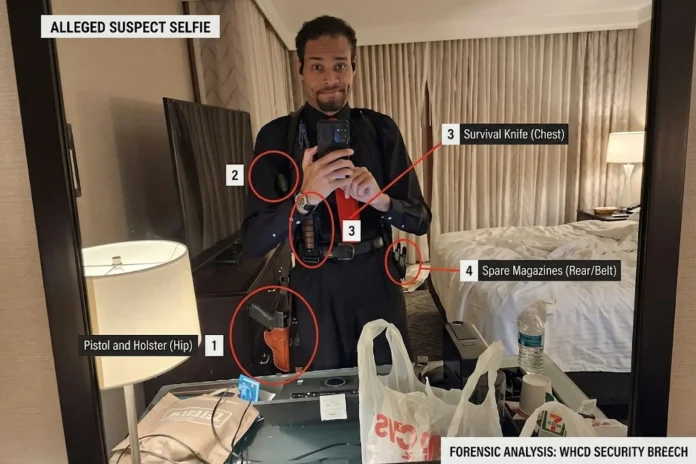
Cole Tomas Allen, a 31-year-old man from Torrance, California, took a mirror selfie in his Washington Hilton hotel room while armed with multiple weapons just minutes before he allegedly rushed a security checkpoint at the White House Correspondents’ Association Dinner and opened fire on April 25, 2026. Federal authorities released the photos as part of court filings detailing the incident that forced the evacuation of President Donald Trump and senior administration officials. The images capture Allen dressed in dark clothing with visible tactical gear, documenting his preparation in the same hotel hosting the high-profile event.
Court documents show Allen purchased a 12-gauge pump action shotgun in August 2025 and a .38 caliber semi-automatic pistol in October 2023, both later recovered in connection with the attack. He traveled by train from the Los Angeles area through Chicago before arriving in Washington, D.C. and checking into the Hilton. Shortly after 8 p.m. local time, while inside his room, he photographed himself armed and then prescheduled messages including an explanation of his actions that were sent around 8:30 p.m. He left the room carrying the shotgun, handgun, and several knives before charging the checkpoint near the ballroom.
One Secret Service agent was struck by gunfire but protected by a bulletproof vest and later released from the hospital. No other serious injuries were reported among attendees or officials. Allen exchanged shots with law enforcement before being tackled and subdued near a staircase leading toward the main event area. Prosecutors charged him with attempt to assassinate the President, transportation of a firearm and ammunition in interstate commerce with intent to commit a felony, and discharge of a firearm during a crime of violence. He was arraigned in U.S. District Court in Washington, D.C.
The writings attributed to Allen express clear anger toward Trump administration policies and describe his intent to target officials, referring to himself in one document as a “Friendly Federal Assassin.” This material, combined with his digital activity monitoring the presidential schedule that evening, points to significant premeditation. Neighbors and former associates in Torrance described him as a quiet individual who worked as a part-time teacher and tutor after earning degrees in mechanical engineering from Caltech and computer science from Cal State Dominguez Hills. Many expressed shock at his alleged involvement given his previously unremarkable public profile.
The release of the hotel room photos underscores how self-documentation has become part of modern high-profile incidents, offering investigators a direct visual record of preparation while raising questions about the psychological drivers behind such acts. In an era of polarized politics, this case highlights the persistent challenge of identifying individuals who move from online or private grievances to real-world violence despite no apparent prior criminal record. Security protocols at major Washington events will likely face renewed scrutiny in the aftermath, even as the swift response prevented greater harm inside the ballroom.
Federal investigators continue examining Allen’s full background, online history, and movements in the days leading to the dinner. The incident disrupted what was intended as a night of press and political engagement but instead exposed vulnerabilities in protecting high-level gatherings. Americans across the political spectrum can agree that political violence has no place in public life, regardless of the underlying frustrations that fuel it. The judicial process now moves forward to determine accountability based on the evidence presented in court.
For the official Department of Justice announcement on the charges, see the press release. Details from the criminal complaint provide further context on the timeline and evidence. Court records also outline the specific firearms linked to Allen through purchase records.