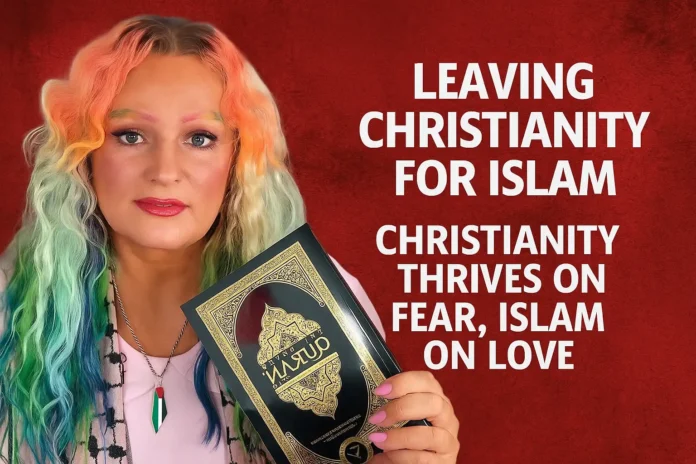
A liberal woman’s bold declaration to abandon Christianity for Islam, citing love as the driving force behind her choice, has sparked intense online discussion. In a viral video, she explains her two-year journey toward converting to Islam, claiming that Christianity operates on fear while Islam is rooted in love. Her statement, which includes a provocative critique of Christianity as
“one of the most powerful and evil religions,”
has raised eyebrows and prompted debates about faith, geopolitics, and personal transformation.
The woman reflects on her evolving beliefs in the video, stating,
“The last two years have changed me, and honestly, I don’t think I can call myself a Christian anymore.”
She contrasts Christianity’s fear-based teachings with what she perceives as Islam’s emphasis on compassion and community.
Her decision appears influenced by her experiences “on the front lines with Muslims,” possibly in social justice or humanitarian contexts, and her frustration with Christians who she says watch “genocide like it’s entertainment.” She also references Jesus as Palestinian, tying her spiritual shift to geopolitical issues like the Israeli-Palestinian conflict.
Her perspective may stem from disillusionment with certain Christian teachings or communities. Some Christian denominations emphasize sin and judgment, which can feel fear-driven to those seeking a more compassionate faith. Meanwhile, Islam’s focus on Allah’s mercy and practices like charity and communal prayer may have resonated with her.
Her mention of being “on the front lines” suggests interactions with Muslim activists, potentially deepening her admiration for Islam’s sense of solidarity, especially on issues like Palestinian rights.
However, her sweeping claims about Christianity and Islam invite scrutiny. Both religions have complex histories and diverse interpretations. Christianity, with 2.4 billion followers, teaches love and forgiveness through verses like “love your enemies” Matthew 5:44, but some interpretations focus on hell or exclusivity, which could feel fear-based.
Islam, with 1.8 billion adherents, emphasizes mercy but also includes strict punishments in certain interpretations, like apostasy laws in some Muslim-majority countries.
Violence tied to both religions complicates her narrative. Christian-related violence, such as the 2011 Norway attacks by Anders Breivik, who killed 77 people while invoking a “Christian Europe,” or Anti-Balaka militias targeting Muslims in the Central African Republic, often stems from ethno-political conflicts rather than theology. Conversely, Islamist groups like ISIS, responsible for atrocities like the 2014 Sinjar massacre, or Boko Haram’s attacks on Christians in Nigeria, justify violence with extreme interpretations of Islamic texts, though most Muslims reject these.
According to Bridge Initiative, 86% of U.S. Muslims reject violence in the name of faith, highlighting the disconnect between extremism and mainstream belief.
Conversions between religions are not uncommon. Globally, Islam’s population growth is primarily due to higher birth rates, with conversions into and out of the faith roughly balancing out, with many Christians drawn to its structure and community, while millions of Muslims convert to Christianity, often citing Jesus’s teachings or personal spiritual experiences.
Converts to Christianity in Muslim-majority countries face severe persecution, including death penalties for apostasy in places like Afghanistan, as noted by Open Doors USA. Converts to Islam in Christian-majority countries, like the woman in the video, typically face social stigma but not legal repercussions.
Her reference to Jesus as Palestinian and Christians’ inaction on “genocide” likely points to the Israeli-Palestinian conflict, a deeply divisive issue. This geopolitical lens may amplify her rejection of Christianity, which she associates with Western powers, and her embrace of Islam, seen as aligned with marginalized groups.
Yet, her stark contrast between the two faiths oversimplifies their complexities, ignoring the diversity within both.
The woman’s public denouncement, made “in the name of Allah,” signals a firm commitment despite anticipating consequences. Her journey reflects a broader trend of spiritual seekers reevaluating faith through personal and political lenses. As her video circulates, it continues to spark conversations about religion’s emotional and ethical foundations in a polarized world.