

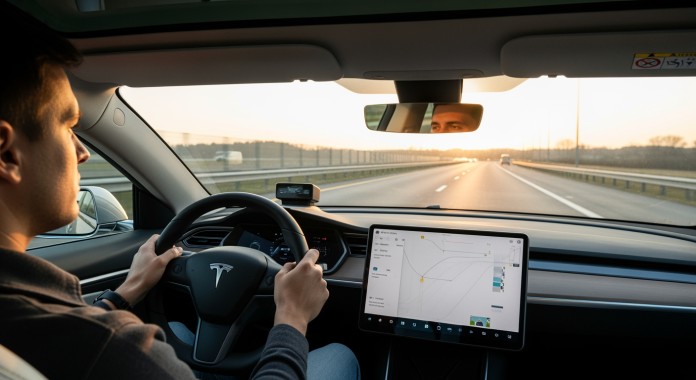
Tesla’s Full Self-Driving (FSD) system is undergoing a continuous evolution, with its real-world highway performance now drawing closer examination. A recent user experience, offering unique insight into FSD’s current capabilities and limitations, has fueled new discussions about the path of autonomous technology. This firsthand account details how FSD navigates complex highway environments, showcasing both its strengths and areas requiring further refinement.
The experience, shared by a Tesla owner, involved navigating diverse highway scenarios. The driver traveled busy interstates, encountering conditions from construction zones to heavy traffic. The system demonstrated consistent ability to maintain lane discipline and adjust speed effectively.
However, the user’s account also highlighted challenges. These included difficulties with merging onto highways and managing complex interchanges, situations considered crucial for comprehensive highway driving. The owner’s feedback provided an objective view of the system’s current state, directly from real-world testing.
Key aspects of the FSD experience included its proficiency in maintaining a safe following distance and reacting to sudden braking by other vehicles. The system handled basic highway driving tasks smoothly, underscoring its significant potential. Yet, areas for enhancement were also clear.
The system struggled to process and react to unexpected events. This included instances within construction zones where lane markings were unclear and situations involving erratic behavior from other drivers. Such observations are vital for understanding the maturity level of current autonomous vehicle technology.
Elon Musk and Tesla are actively working to improve FSD. The company has recently deployed software updates specifically designed to enhance highway performance. The latest version of FSD v14 started rolling out in early October 2025 to select users, with Elon Musk announcing its release on October 7, 2025. Subsequent versions, such as v14.2 and v14.2.1 (e.g., 2025.38.9.5/6, 2025.44.25.5), appeared in late November and December for wider (though still supervised) distribution, introducing vision upgrades and improved handling of complex scenarios.
Safety Report: The Q2 2025 report showed significantly fewer crashes per million miles with Autopilot/FSD engaged (1 crash per 6.69M miles) compared to disengaged (1 per 963k miles), reinforcing its safety claims.
Major Software Update (v14.2): A significant update integrates Robotaxi AI insights, boosting performance with 10 times more parameters, reducing “nag” (warnings), and providing smoother control, resulting in less frequent driver interventions.
FSD Unsupervised: Plans were announced to introduce a truly driverless FSD version in certain cities by late 2025.
Hardware Strategy: Tesla has paused HW3 upgrades, focusing on future hardware (AI5 is expected to be released late 2026) and emphasizing software/AI advancements.
Usage Growth: By Q3 2025, FSD (Supervised) mileage hit a new record, averaging 14.1M miles daily.
User Experience: New speed profiles (Sloth and Mad Max) and a more substantial driver profile impact were added to support personalized driving styles.
In essence, Q2 2025 marked a pivotal time where Tesla showcased FSD’s maturing safety record, planned its transition to unsupervised driving, and refined the user experience with advanced AI features.
While these improvements show promise, the user’s report reinforces that the technology remains in development. Further refinements are necessary, a point emphasized by the rapid pace of advancement in the field.
A primary takeaway from this extensive user experience is that despite its advanced nature, FSD is not yet flawless. The system sometimes falters in high-stress situations. The user underscored that active driver vigilance remains essential. For those utilizing self-driving cars, FSD demands full human attention.
As technology advances, the distinction between assisted and fully autonomous driving is expected to become increasingly blurred. A growing number of individuals are now using FSD, generating a broader range of operational data for developers.
The future of autonomous driving on highways appears promising, contingent on continuous improvements. The integration of AI and machine learning is anticipated to play a significant role in advancing FSD. The user’s perspective ultimately reinforces the critical importance of safety and ongoing development. The next generation of autonomous vehicles will likely offer enhanced features to manage all highway complexities better. The path toward fully autonomous highway driving continues to require substantial technological advancements and careful consideration.
