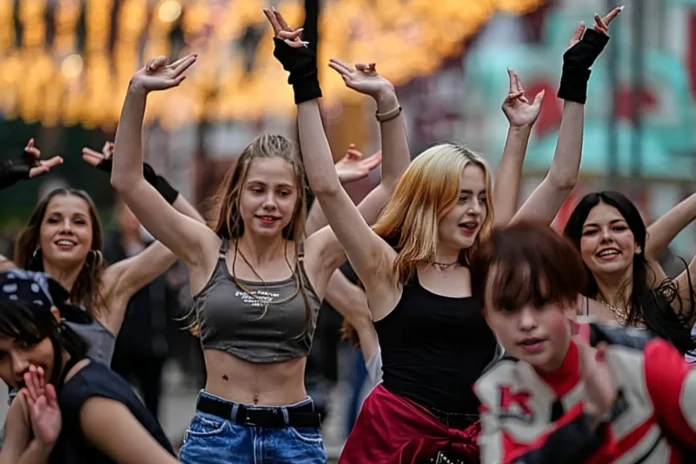
Two teenagers lock eyes in a Mexico City plaza. Phones rise around them. Spectators lean in. No punches fly. Instead, one leaps into Cristiano Ronaldo’s signature “Siuuu” celebration. The other responds with a sharp jawline pose known as mewing, then grabs a giant white sandal and mimes lassoing his rival like a horse.
This is an “aura battle.” Competitors trade short bursts of poses, dances, facial expressions, sports celebrations, props, and meme references. The crowd’s cheers, laughs, or silence decide who projects the most charisma, confidence, style, and effortless cool what Gen Z calls “aura.”
The trend grew from “aura farming,” online slang that treats coolness like a video-game score. “Farming” means grinding for points or resources. Users once joked about “+10,000 aura” for smooth moments and “-50,000” for awkward ones. By August 2026 the joke left screens and turned into real gatherings across Mexico, Argentina, Brazil, Peru, Bolivia, and Costa Rica.
In one widely reported Mexico City final near the Palace of Fine Arts, 14-year-old Carlos Irving Quintana purple-haired and nicknamed “Thanos” reached the last round with Ronaldo leaps and mewing. He fell to 16-year-old Kaled Rosales Salazar, whose sandal lasso and Lightning McQueen-themed clogs won the day. Organizer Aldhir González, 22, put the standard simply:
“Whoever looks the best, shows it off, gets the most laughs and has the most confidence wins.”
Prize money is real but not uniform. Some Mexico City events have paid winners 2,000 or 3,000 Mexican pesos (roughly $100–$180). Other spots offer only bragging rights and “infinite aura.” Reports vary by organizer and location; no single figure applies everywhere.
Local authorities have occasionally stepped in. A Honduran mayor banned them in one municipality. A Brazilian mayor blocked a public-space event. In Mexico City, Mayor Clara Brugada welcomed the gatherings as peaceful ways for young people to reclaim plazas and step away from screens.
The appeal is clear low barriers, instant shareability, and a chance to practice confidence offline. For U.S. readers the story lands as a vivid reminder that TikTok slang does not stay digital. It can jump into public squares, create new rituals, and show how a generation turns imaginary points into real-world presence and sometimes a little cash.