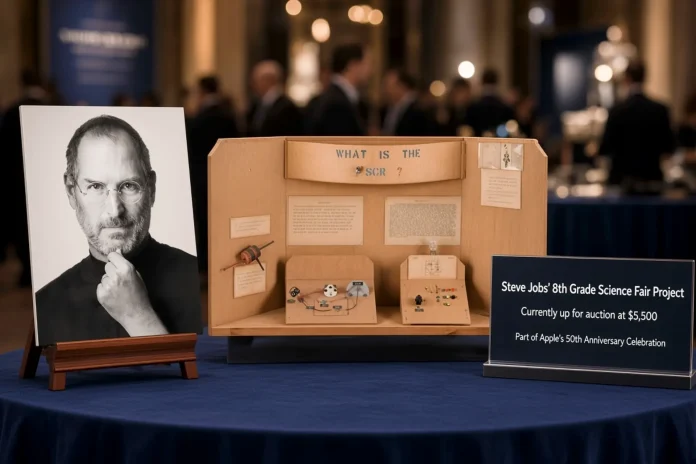
Steve Jobs’ eighth-grade science fair project, built when he was 13, is up for auction with current bidding at $5,500 and an estimate of $20,000 or more.
The piece, titled “What is the Silicon-Controlled Rectifier?” and dated February 29, 1968, features a plywood display board roughly 32.5 inches by 18 inches by 7.5 inches. It holds two working demonstration circuits, a wooden model of a typical silicon-controlled rectifier with its four layers of P- and N-type semiconductor material, hand-drawn diagrams, and a 10-page typewritten report bound in a blue folder. A label on the board reads “Submitted by Steve Jobs, Cupertino J.H., 8th Grade.“
Jobs left clear instructions for the judges. One note still attached to the exhibit tells them how to operate the circuits and stresses that they must unplug the setup afterward:
“Judges, if you wish to see this operate, please plug in Circuit II and oscilliscope and unplug, please unplug!, after using. The oscillipscope should already be set for two to four stationary cycles, but if necessary, judges, please make proper adjustments.”
The double warning appears aimed at preventing the circuit from burning out if left running.
The report opens with Jobs explaining his choice of topic.
“For my science project I have selected to do research and experiment with the silicon-controlled rectifier,”
he wrote.
“I am making a circuit that demonstrates the basic properties and characteristics of this semiconductor.”
He described the SCR as the most widely used of a family of four-layer semiconductor power devices that exhibit regenerative or latching-type switching action, and noted that international standards group them under the name thyristors. The center panel of the board shows one circuit built to illustrate the SCR’s basic principles and another designed for its most common uses at the time, such as motor speed control and light dimming.
The project stayed at the Jobs family home in Los Altos for decades, stored in the same property that later housed the garage where Apple began. After Paul Jobs died in 1993, his widow Marilyn continued living there. Steve Jobs helped sort through his father’s belongings but declined to take many personal items, including the science project. His stepbrother, John Chovanec, whose mother Marilyn married Paul Jobs in 1990 with Steve serving as best man, later moved the exhibit to his own home after Jobs told him to keep it and not bother him about it again. Chovanec has preserved it carefully ever since.
RR Auction is offering the project as Lot 4006 in its “Steve Jobs & the Computer Revolution: The Apple 50th Anniversary Auction Part Two.” Bidding opened in late July 2026 and ends August 20, 2026, under the house’s 30-minute rule beginning at 7 p.m. EDT. The sale includes more than 200 lots tied to Apple’s history, among them a fully functional 1977 “Neumark” Apple-1, early prototypes, signed documents, and other items with family provenance — a striking contrast to Apple’s later manufacturing pivot. Part one of the anniversary series earlier saw the first check issued by Apple Computer sell for $2.4 million.
Apple marks its 50th anniversary this year by highlighting the company Jobs co-founded with Steve Wozniak in 1976 in that Los Altos garage. Jobs drove the early success of the Apple II and Macintosh, then returned in 1997 after a 12-year absence to pull the firm back from near collapse. Under his leadership the company introduced the iPod, iPhone, and iPad, products that redefined personal computing, portable music, and mobile phones. Design simplicity, tight hardware-software integration, and focus on the user experience became the company’s hallmarks during those years — and the firm is now navigating Apple’s most recent leadership change.
Jobs is widely regarded as a legend for the scale of those changes. He helped shift computers from tools used mainly by specialists into devices ordinary people wanted in their homes, and has been praised for his product-focused vision by tech leaders and admirers ever since. Later he did the same for music players and smartphones, turning them into everyday objects that shaped how people communicate, work, and create. His insistence on clean industrial design and controlled retail experiences influenced industries far beyond technology. Collectors and historians treat early personal artifacts like this science project as tangible links to the start of that path.
Jobs was born February 24, 1955, and turned 13 just days before completing the report. Around that period he had cold-called Hewlett-Packard co-founder Bill Hewlett to request spare parts for a school project, an outreach that led to a summer job testing electronic components on the HP assembly line. The SCR project is widely viewed as that early effort. It remained unused in the family home until Chovanec, who later worked at Apple, decided to consign it and other preserved pieces for the company’s 50th anniversary year.
The auction page lists the lot in overall very good to fine condition. Provenance is documented as coming directly from Chovanec’s personal collection. Collectors of early Jobs and Apple material have driven strong prices for comparable artifacts in recent years, and the current bid of $5,500 after 17 bids already sits well above earlier reported levels under $3,000, on par with Bill Gates’ $30.8M Da Vinci notebook purchase back in 1994.
Anyone interested can view the full lot description and place bids at the RR Auction site. The sale closes August 20.