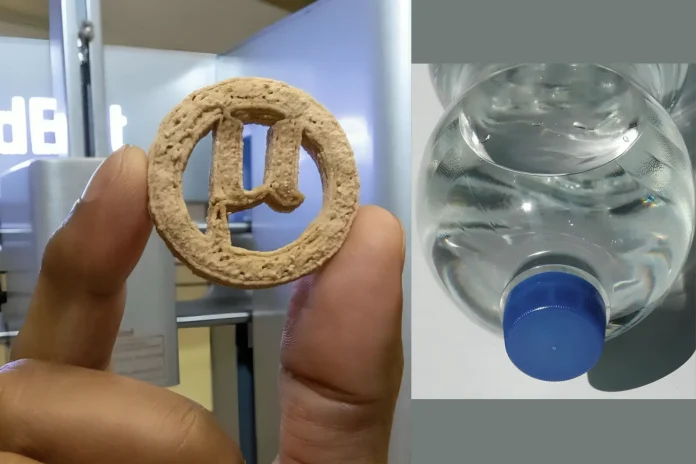
Water from a plastic bottle being used to make a cookie seems like a perfect example of internet clickbait. However, researchers at Southern Illinois University Carbondale have managed to do that, but there are specifics behind it.
They are not grinding bottles into dough. The team breaks down PET plastic (the kind in soda and water bottles) plus corn stalks and other agricultural waste using oxidative hydrothermal dissolution: water, oxygen, heat, and pressure. That creates smaller carbon-rich molecules. Engineered yeasts then convert those molecules into proteins, fats, acids, vanilla flavor compounds, and beta-carotene. Fiber, starch, and sweetener get mixed in. A 3D food printer shapes the result into ring-like protein-rich cookies called µBites (pronounced “microbites”).
“We were trying to develop technologies for plastic upcycling to make more valuable products. We thought, why not focus on making food? Because plastic is carbon and food is carbon,”
said Associate Professor Lahiru Jayakody. Graduate student Sandhya Jayasekara added that the team is using microbes
“to develop the cookie into a more attractive, consumer-friendly product.”
Jayakody also noted,
“Microbes are very clever. So, we are using their traits to solve the problems we created.”
This research was presented in the American Chemical Society Fall 2026 meeting in Chicago. Its applications could be in space expeditions, disaster sites, submarines, and any other place where food resources are difficult to sustain.
Lab and third-party tests indicate µBites are free of toxic chemicals, heavy metals, allergens, and pathogens, so researchers describe them as safe to eat based on available data. Formal human taste tests still await institutional approval. No public descriptions of flavor exist, and the project is an experimental prototype not FDA approved, not commercially available, and not heading to grocery shelves soon.
The public response has shown that there is definitely a “yuck factor” involved. Many individuals find themselves feeling queasy about the consumption of food associated with plastic waste, even after it has been reassembled back into biological molecules through the removal of the carbon atoms. The main challenges faced here are scaling up the process, adhering to food guidelines, maintaining the cost factor, which at present has been estimated to be around $60 per kilogram, and consumer acceptance.
The science behind µBites is real. The viral version needs context. This is not a plastic bottle ground up and baked into a cookie. Americans should not expect to find µBites in stores anytime soon.