

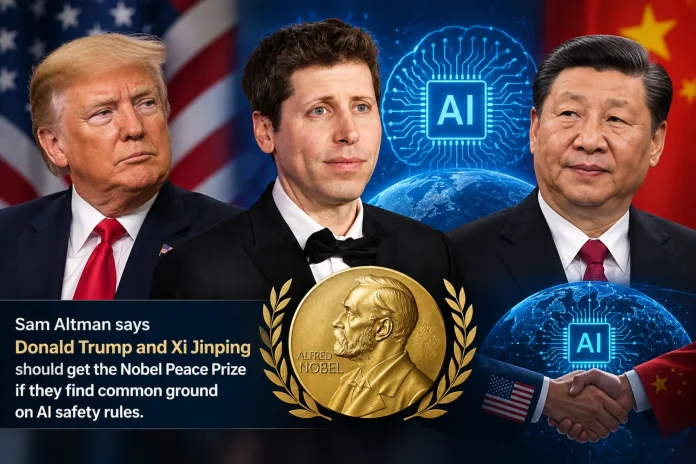
OpenAI CEO Sam Altman has proposed an unusual sweetener for one of the world’s most consequential rivalries: if President Donald Trump and Chinese President Xi Jinping can agree on basic safety rules for artificial intelligence, the two leaders could share the Nobel Peace Prize.
Altman made the suggestion during a wide-ranging interview published Friday by Fortune with Editor-in-Chief Alyson Shontell, framing it not as a call to stop the U.S.-China AI race but as a way to keep that race from pushing either side into unacceptable risks. The proposal comes days before Trump hosts Xi at a high-profile state dinner in Washington on Thursday, 24 September 2026, with AI expected to dominate the broader conversation about U.S.-China technology competition.
“I think Presidents Trump and Xi would get the Nobel Peace Prize together if they could agree on something that should be easy to agree to, and it would be wonderful,”
Altman told the outlet.
“Even if just the U.S. and China could agree on some shared standards and testing for development of this technology, I think that’d be a wonderful accomplishment that the two of them can deliver.”
Altman’s framing — competition can continue, but a shared safety floor must exist beneath it — reflects a view that has gained traction across the AI industry as frontier models approach capabilities that could reshape economic and military power. In the same interview, Altman argued that
“in the extreme case, the U.S. and China are both worrying that if one country gets superintelligence first, that’s a big imbalance of power in that relationship. On the other hand, neither of us should be taking loss-of-control risk in the race to beat the other country.”
For Altman, the basic concept would be relatively straightforward. He suggested the two countries could agree on rules covering how powerful AI systems are developed and tested, what kinds of risks should trigger additional safeguards, and how both sides could monitor whether those standards are being followed. He described the potential agreement as something that could fit into a “one-page document,” though he acknowledged that defining exactly what should be restricted or monitored would be considerably more complicated. Asked whether a ban on recursive self-improvement — AI that can continuously upgrade itself and add capabilities — would suffice, Altman replied to it probably would not.
The timing of Altman’s pitch lands hard against the backdrop of an industry in open turmoil over safety. Anthropic researcher Jacob Coxon resigned publicly the week before the interview ran, accusing both companies of “racing straight to self-improving superintelligence and gambling with our lives,” per the same outlet. Anthropic’s head of alignment, Evan Hubinger, responded that
“we really do earnestly believe AI could kill all humans,”
putting the odds of that happening within the next decade at more than 10%. Anthropic CEO Dario Amodei separately announced a new safety measure committing to give outside evaluators permanent, employee-level access inside the company.
Altman also told the outlet he expects the leading AI labs may soon announce a pact of their own to slow development and address safety risks collectively. While labs “feel the gravity of this moment,” he said, the geopolitics between the U.S. and China represent a different dynamic. Billionaire investor Paul Tudor Jones made a similar case in a Wednesday Wall Street Journal op-ed, writing:
“A new superpower is about to enter the fray, one that is unknowable and unending and potentially dwarfs the U.S. and China individually or collectively,”
and urging Trump and Xi to make AI safety their top priority.
The state dinner on Thursday will bring the architects of that future into the room. According to Bloomberg, as cited by the Times of India, the guest list includes OpenAI’s Sam Altman, Microsoft CEO Satya Nadella, Nvidia CEO Jensen Huang, Apple’s Tim Cook, and Qualcomm CEO Cristiano Amon. That roster places the chief executives of the four most valuable AI-infrastructure companies in the world directly into the diplomatic backdrop of the Trump-Xi meeting. Hypefresh has tracked several of those companies in earlier coverage, including Jensen Huang’s Nvidia milestones and the U.S. decision to shut down Nvidia’s H20 chip sales to China.
Altman’s proposal is not without significant obstacles. Both countries want to remain at the forefront of AI development, and each has concerns that restrictions could give the other side a strategic advantage. Washington has increasingly treated AI as a matter of economic and national security, while Beijing has made technological self-reliance a major national priority. That makes AI safety an unusual diplomatic problem: the United States and China may have a shared interest in preventing catastrophic failures, but they also have powerful incentives to ensure they are not the country that slows down first.
Recent discussions have explored the possibility of creating mechanisms for the two countries to notify each other about particularly serious AI-related incidents, and U.S. and Chinese officials have discussed how they could communicate about AI risks without compromising strategic interests. Neither side has publicly endorsed Altman’s specific framework, and analysts have pointed to deep disagreements over AI regulation, national security, technological access and the role of government that make cooperation far more complicated than simply agreeing on a few technical standards.
Altman compared the moment to the 1996 film Independence Day, in which rival groups put their differences aside to confront a larger threat.
“It feels a little like Independence Day,”
he said. In his view, AI could represent one of those rare issues capable of forcing geopolitical competitors to recognize a shared interest. The Nobel Peace Prize, he suggested, would be a fitting reward — though the award itself would be unusual for an AI-related accord; the Nobel committee has historically honored peace agreements tied to armed conflicts, ceasefires and human-rights breakthroughs rather than technology accords.
The idea of awarding a U.S. president the Nobel Peace Prize is not new. Hypefresh’s earlier coverage tracked John Legend’s endorsement of Trump’s 2026 Nobel candidacy and John Cena’s characteristically cautious response — both part of an ongoing public campaign to associate Trump with the prize. Altman’s proposal extends that conversation into the AI arena.
The parent company behind Altman has been at the center of a string of recent headlines beyond the Nobel pitch. Hypefresh has covered its legal fight with Apple over alleged theft of product data, its accusation that DeepSeek illegally trained on its models, the alleged leak of an xAI engineer’s codebase, and Altman’s $50 billion Saudi funding push. The CEO has separately faced public backlash over surrogacy parenthood.
Whether Washington and Beijing can turn Altman’s idea into an actual agreement remains an open question. The state dinner on Thursday will provide the first real indication of whether the two governments can move from competing over AI to establishing common rules for its most powerful systems. Until then, the Nobel Peace Prize remains only Altman’s hypothetical incentive — and the proposal one is a much harder sell than the headline.
Reporting based on Sam Altman’s exclusive interview with Fortune Editor-in-Chief Alyson Shontell, published 12 September 2026, and the Times of India syndication of 22 September 2026. State dinner guest list attributed to Bloomberg. Additional context from Hypefresh’s earlier coverage of related AI-safety developments. As of publication, neither the White House nor Xi’s office has confirmed the final state-dinner roster.

