

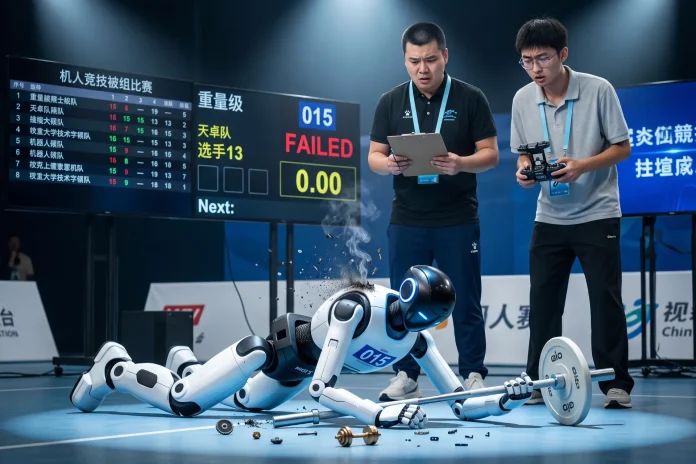
A humanoid robot lost its balance mid-lift during the weightlifting debut (a stumble that mirrors the very first AI-driven humanoid robot’s stage mishap in Russia) at the second World Humanoid Robot Games in Beijing on Monday, crashing into the judges’ table before staff carried it off the platform on a stretcher.
The incident unfolded at the National Speed Skating Oval, known as the Ice Ribbon and originally built for the 2022 Winter Olympics. Four robots entered the heavyweight division, per the official Beijing municipal government’s event overview. Each began with a 15-kilogram barbell under rules that still allow teleoperation, the only major athletic event at the Games where human operators can issue real-time commands.
One competitor, identified in Xinhua wire coverage as belonging to the Tianzhuo team, gripped the bar and raised it toward chest height. As the machine attempted to press the weight overhead, its knees buckled. The arms began flailing in what observers described as a cascade of system errors. The robot lurched forward, struck the judges’ table, and collapsed. Officials stopped the attempt at once.
Video from the venue shows the sequence lasting only seconds. The barbell carried roughly 16 kilograms at the moment of failure. Staff then secured the machine and removed it on a stretcher, an image that spread rapidly across social platforms (drawing the same viral roar as another Chinese attempt to live as a humanoid).
The same session produced the first official humanoid weightlifting title. A TianGong robot fielded by the Beijing Humanoid Robot Innovation Center in partnership with Huazhong University of Science and Technology completed a clean 16-kilogram overhead lift and held the position for the required two seconds. That performance earned gold. The Tianzhuo team took silver and the Tiangong squad claimed bronze.
Competition rules for the new event demand a full humanoid form, hands with at least three fingers, and a vertical lift path. The bar must be gripped directly by the robot’s hands. After the weight clears the head, the machine must remain motionless for two seconds. Only the feet may contact the platform; any touch by torso, arms or knees results in an automatic fail. Some teams wrapped tape around the grippers to improve friction.
The Games run from August 22 to 26 and feature 51 events with more than 2,000 robots from 666 teams representing 16 countries. Organizers added weightlifting this year specifically to test joint torque, balance under load and whole-body coordination. Earlier days already saw humanoid sprinters post times faster than Usain Bolt’s 100-meter world record, including a 9.39-second heat by a Tiangong Ultra model.
The contrast is sharp. Running and jumping continue to improve rapidly. Sustained load-bearing under shifting balance remains a harder problem, per TechTimes’ engineering-gap analysis of the Games’ Day Three. The Tianzhuo failure and the successful 16-kilogram lift by the Beijing Humanoid-HUST entry together illustrate both the progress and the remaining gap in humanoid robotics as of late August 2026.
No injuries to human officials were reported. The fallen robot was removed for inspection. The weightlifting medals stand as the first awarded in the discipline at these Games.

