

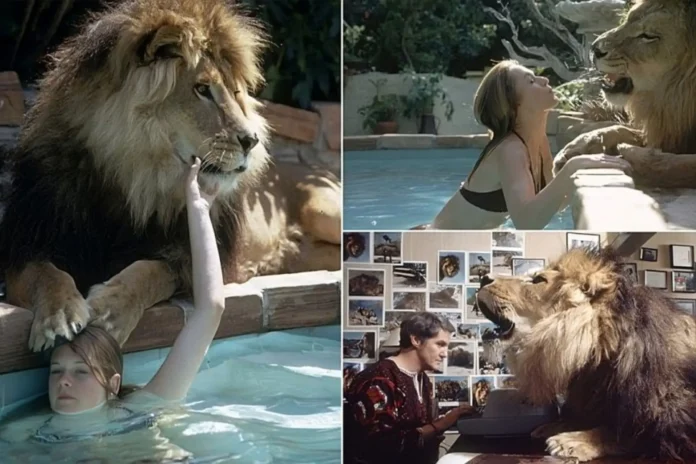
In 1981, a film called Roar shocked Hollywood with a production so perilous it nearly cost lives, leaving over 70 cast and crew members injured in a grueling 11-year ordeal. This adventure comedy, born from a family’s passion for wildlife, earned its infamous title as “the most dangerous movie ever made” by throwing untrained lions, tigers, and other wild animals into the mix. The story of Roar is a wild, heart-pounding saga of ambition, sacrifice, and sheer audacity that still captivates audiences today.
It all started in 1969 when director Noel Marshall and his wife, actress Tippi Hedren, witnessed lions taking over an abandoned house in Mozambique while shooting Satan’s Harvest. Moved by the sight, they dreamed up a movie to champion wildlife protection. By 1976, they began filming in Soledad Canyon, California, on a set built to resemble Tanzania’s rugged landscape. The production housed a jaw-dropping 71 lions, 26 tigers, leopards, cougars, and even elephants. Every professional animal trainer they approached turned them down, warning the project was too dangerous. Undeterred, the family opted to work with untrained animals, a decision that would define the film’s chaotic legacy.
The set was a crucible of danger. Over 70 people were injured, some gravely. Noel Marshall, doubling as the film’s star, Hank, endured over 11 lion bites, one so severe it led to gangrene that nearly cost him a limb. Tippi Hedren, known for her role in The Birds (1963), was bitten on the head by a lion, fractured her ankle under an elephant’s weight, and suffered scratches from a leopard. Her daughter, Melanie Griffith, barely escaped losing an eye after a lioness attack that required 50 stitches. Cinematographer Jan de Bont was scalped by a lion, needing 220 sutures, yet he bravely returned to the camera. Noel’s sons, John and Jerry Marshall, were hospitalized after lion bites, with John needing 56 stitches. The production also faced tragedy when 14 animals died from airborne illnesses, compounded by fires, floods, and disease that plagued the 11-year shoot.
Roar was a deeply personal mission for the Marshall family, who went so far as to keep some animals at their Sherman Oaks home. The financial toll was staggering, with the budget ballooning to $17 million, funded by selling four houses, 600 acres of land, and profits from Marshall’s earlier success with The Exorcist. Despite this sacrifice, the film flopped, grossing just $2 million worldwide after its 1981 release, with no initial U.S. screenings. A 2015 re-release by Drafthouse Films added a modest $110,048, but the movie’s raw intensity earned it a 72% approval rating on Rotten Tomatoes and a cult following drawn to its terrifying animal encounters.
The decision to work with untrained animals triggered vigorous ethical debate. While Roar aimed at drawing attention in favor of wildlife conservationism, the death of humans was raising uncomfortable questions regarding safety. Tippi Hedren went on to devote her energies towards the setting up of the Roar Foundation and the Shambala Preserve, an animals’ sanctuary from the film, in honor of her devotion towards the cause. Critics admired the film’s grandiose vision but panned the rickety plot and uneven tempo, some calling it “the most expensive home movie ever made.” Roar: The Most Dangerous Movie Ever Made, a 2017 documentary film, shed light on the madness of the production by unearthing harrowing behind-the-scenes content and interviews in a raw analysis of the risks taken.
Years later, Roar stands as proof of bold if reckless filmmaking. Its marriage of visceral danger and nonconformist charm has made it a cult film, appealing to audiences interested in the very close call that was production.
