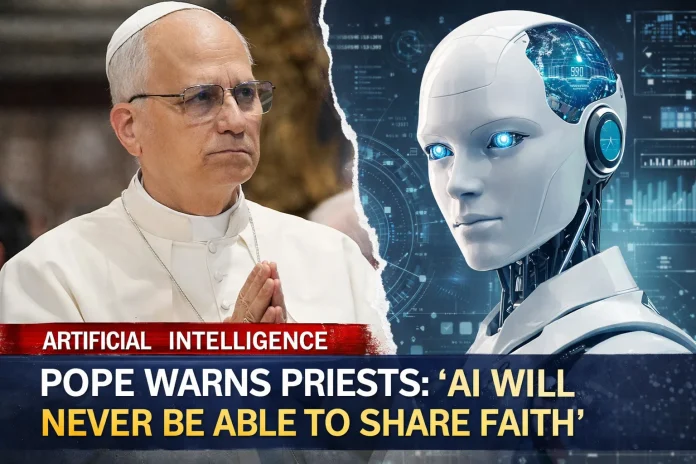
Pope Leo XIV is drawing a clear boundary between artificial intelligence and authentic faith.
During a meeting with clergy from the Diocese of Rome, the first U.S.-born pontiff warned priests against using AI platforms such as ChatGPT to write their sermons, stressing that while technology is playing a growing role in daily life, it cannot replace lived spiritual experience.
Addressing the rapid expansion of digital tools in modern culture, Leo cautioned clergy not to depend on them for spiritual guidance. According to Vatican News, he described the use of AI in sermon preparation as a “temptation,” warning that outsourcing homilies to chatbots could gradually weaken a priest’s intellectual and pastoral discipline.
“Like all the muscles in the body, if we do not use them, if we do not move them, they die,” the pope said. “The brain needs to be used, so our intelligence must also be exercised a little so as not to lose this capacity.”
He made clear that preaching is not merely about structure, polished wording or delivery. “To give a true homily is to share faith — and AI will never be able to share faith,” he added.
Leo emphasized that effective sermons must be rooted in personal conviction and shaped by the realities of each parish community. “If we can offer a service that is inculturated in the place, in the parish where we are working,” he said, “people want to see your faith, your experience of having known and loved Jesus Christ.”
The remarks form part of the pope’s broader reflections on emerging technologies. In previous addresses, he has spoken about the rise of AI chatbots and virtual influencers, warning that overreliance on such tools risks displacing genuine human relationships if not approached carefully.
The debate has also taken on an international dimension. Some social media users contrasted Leo’s warning with experiments in Japan, where Kyoto’s Kōdaiji Temple introduced an android known as Mindar in 2019. Designed to deliver Buddhist teachings, the robot was intended to spark interest among younger visitors and address clergy shortages. The project became a flashpoint in conversations about whether technology can meaningfully step into spiritual roles.
The Catholic Church has engaged AI ethics discussions in recent years, particularly under Pope Francis, who supported initiatives promoting human-centered AI development. But Leo’s remarks draw a clearer boundary when it comes to preaching — positioning homilies as an inherently human act that cannot be replicated by code.
As AI continues to permeate creative industries — from music production to content writing — Leo’s warning adds a theological voice to a broader cultural question: Just because technology can generate something convincing, should it replace the real thing?
For now, the pope’s answer appears to be no.