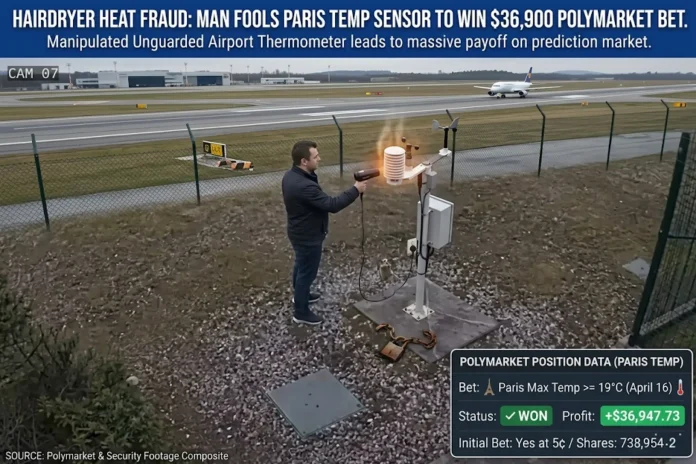
A trader reportedly earned around $36,900 on the prediction market platform Polymarket by using a portable heat source to temporarily spike readings on an unguarded weather sensor at Paris Charles de Gaulle Airport.
The incidents occurred on April 6 and April 15, when the Météo-France temperature probe near the runway perimeter recorded brief jumps to about 22 degrees Celsius, well above the expected highs near 18 degrees Celsius. These spikes registered as the daily maximums, allowing low-probability bets on elevated temperatures to resolve in the trader’s favor and trigger substantial payouts through the platform’s crypto-based settlement.
The method relied on the platform’s use of a single sensor for resolving its daily highest-temperature-in-Paris markets. The location sits accessible from a public road along the airport perimeter, making physical approach straightforward without immediate barriers. Circulating video clips, consistent with security footage, show an individual walking up to the station, directing what appears to be a battery-powered hairdryer or similar device at the probe for several minutes, and then departing. Data logs indicate the temperature rose sharply by 4 to 5 degrees Celsius within about 12 minutes before returning to ambient levels, with no comparable changes at nearby stations. One documented wager involved a roughly $119 stake that paid out more than $21,000 on the April 15 event, contributing to the combined total across both dates.
This case highlights a classic vulnerability in prediction markets that depend on external oracles for real-world data. While blockchain ensures transparent and immutable payouts once a market resolves, the inputs themselves can remain exposed to manipulation if they draw from a solitary, unprotected source. Prediction platforms like Polymarket have built reputations for efficient crowd-sourced forecasting on events ranging from elections to sports, yet weather contracts reveal how low-tech interference can bypass digital safeguards. In response, the platform shifted its Paris temperature resolution source to data from Paris-Le Bourget airport, reducing reliance on the affected CDG station.
Météo-France, the French national meteorological service, conducted a physical inspection of the equipment and analyzed the anomalous readings before filing a criminal complaint with the Roissy airport gendarmerie for alleged tampering with an automated data processing system. French authorities, including the cybercrime division, have opened an investigation, though the trader’s identity remains unknown, linked only to anonymous wallets and profiles on the platform. Potential penalties for such interference could include significant prison time and fines, underscoring the legal risks of exploiting public infrastructure for private gain. Climate enthusiasts at the nonprofit Infoclimat first flagged the irregularities through forum discussions, prompting official scrutiny.
The episode serves as a reminder that even decentralized systems inherit weaknesses from the physical world they reference. Robust oracles often incorporate multiple redundant data feeds or cryptographic verification, yet single-point dependencies persist in niche markets. This incident may encourage platforms to audit resolution sources more rigorously and could spark broader conversations about blending physical security with on-chain economics. For now, the story circulates widely in crypto communities as both a cautionary tale and a display of creative, if questionable, ingenuity in pursuing market edges.
Related: Explore more on prediction market dynamics and emerging tech risks in Elon Musk’s 2026 predictions for AI and beyond, or check our coverage of high-stakes betting trends.