

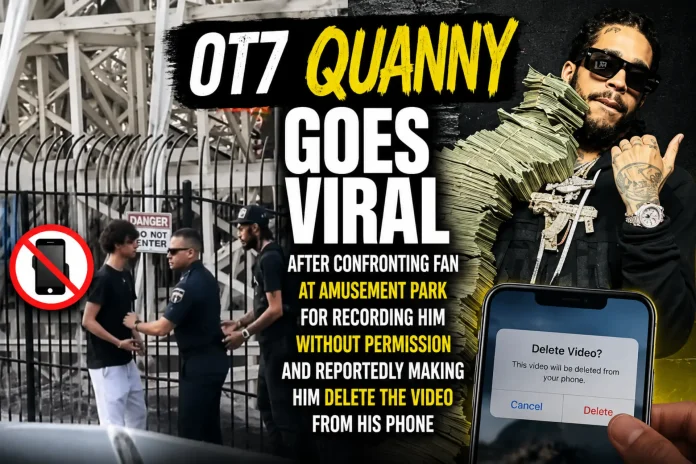
Philadelphia rapper OT7 Quanny confronted a young fan at Dorney Park in Allentown, Pennsylvania on June 7, 2026, after spotting the individual recording him without permission along a crowded walkway near a large wooden roller coaster. In the widely circulated video, the fan lets out an audible “oh shit” as Quanny and his security approach, with Quanny still in his black t-shirt, black shorts, backward cap, and backpack. The 28-year-old gestures firmly toward the fan’s phone and demands the clip be deleted on the spot.
The young man, dressed in a simple black t-shirt and white pants, looks down, unlocks his device, and removes the footage while security stands close by without physical intervention. The entire exchange lasts under 20 seconds but has since reached hundreds of thousands of viewers across platforms, with bystander footage showing families and children walking past in the background under bright daylight. No physical contact occurred, but the directness of the demand has split online observers, some praising Quanny for protecting his peace, others arguing that public figures should accept a baseline of attention, especially from younger fans at family venues.
Born Ja’Quan Borneo-Lee on June 20, 1997, OT7 Quanny has risen from the streets of North Philadelphia to carve out a distinct space in hip hop. His stage name reflects a nonstop hustle, “Overtime seven days a week,” and his profile has grown alongside a string of projects that began with a 2020 feature on Lil Buckss’s “Halftime” and continued with his 2021 solo tape “Virgil II.”
Songs such as “Ok Ok,” “Get That Money,” and “Run The Hood,” along with collaborations alongside Bossman Dlow (a recent subject of a separate accuser-retraction story), have earned him millions of streams and a deal through 10K Projects’ OT7 Quanny partner page with Perfect Timing Records. The Dorney Park confrontation also landed in the middle of an ongoing conversation about how rising artists balance fame and privacy, one that has played out in similar moments for other celebrities from Taylor Swift dodging cameras at a Chiefs game to Jennifer Lopez asking paparazzi to leave her daughter alone and Sydney Sweeney’s recent paparazzi incident.
The Dorney Park moment lands differently for those who know his background. Quanny frequently speaks about his role as a father to a young son, describing in interviews how parenthood reshaped his priorities and gave him new motivation to build a stable future, a perspective that adds a generational layer to a clip that, on its surface, looks like a simple boundary-setting exchange. In past conversations he has discussed balancing personal values, street authenticity, and the desire for normalcy, a tension the viral clip captures almost wordlessly.
The viral exchange also arrived in the same Philadelphia rap ecosystem that has, in recent months, lost rising voices like LGP Qua to gun violence, a reminder of how high the stakes are for young artists trying to enjoy everyday public outings. Quanny’s career continues to build momentum through consistent releases and a dedicated following that connects with his real experiences, with his Spotify profile showing nearly a million monthly listeners and a YouTube catalog of music videos tracing his growth as an artist.
As conversations around digital boundaries evolve, moments like the Dorney Park clip remind everyone that even artists who share their lives through music still deserve basic respect when they step away from the spotlight. For Quanny, that line was drawn firmly in front of a roller coaster, and the internet is still debating where it should sit.

