

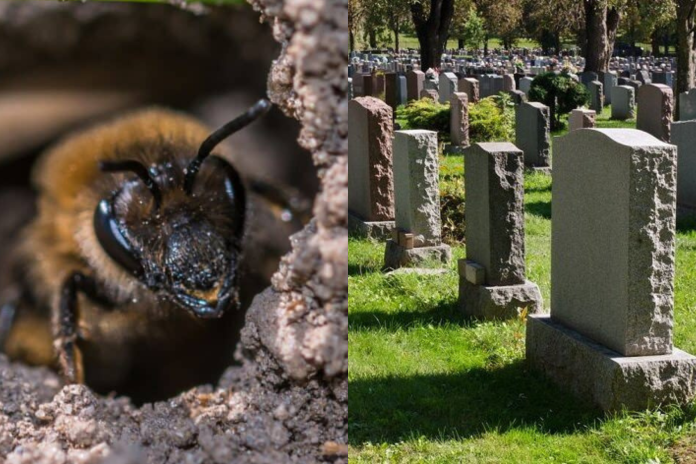
Nature continues to pull off some seriously wild surprises, and the latest one is buzzing right under our feet — literally.
Researchers at Cornell University have documented one of the largest underground bee aggregations ever recorded in the world, tucked beneath the quiet grounds of East Lawn Cemetery in Ithaca. We’re talking roughly 5.5 million bees (with estimates ranging between 3 to 8 million) living across just 1.5 acres of grassy cemetery land. And the kicker? This massive colony has likely been thriving there, undisturbed, for more than 100 years.
The story begins in spring 2022, when Rachel Fordyce, a lab technician in Cornell’s entomology department, was cutting through the historic East Lawn Cemetery (established in 1878) on her way to work to avoid parking hassles. What she saw stopped her in her tracks: thousands of bees swarming the grass. She scooped up a few specimens in a jar and brought them straight to her boss, Professor Bryan Danforth. What started as a casual observation turned into a full-blown scientific study, with findings published this April in the journal Apidologie.
These aren’t your typical honeybees living in a hive with a queen. These are Andrena regularis, a native solitary mining bee. Each female digs her own individual underground burrow, stocks it with pollen and nectar, and raises her offspring alone. When the conditions are just right — like the sandy loam soil and peaceful, low-maintenance environment of this cemetery — they form enormous “aggregations” that can number in the millions.
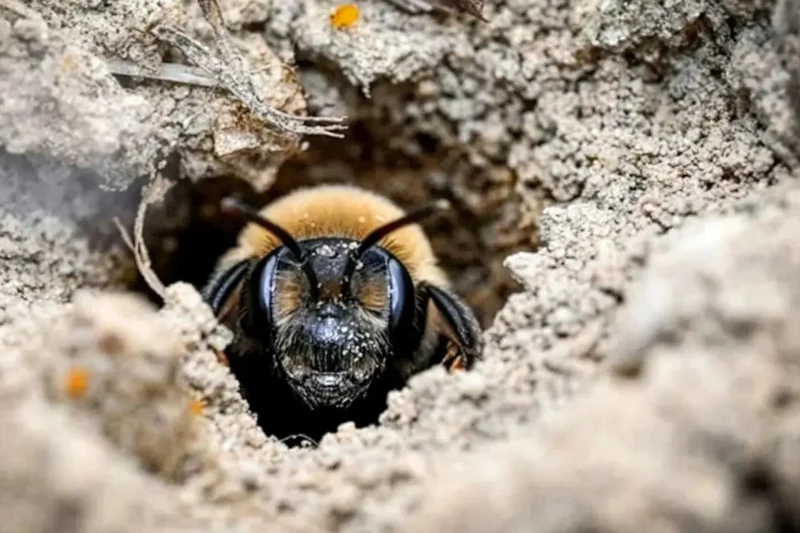
For scale: this single 1.5-acre patch holds the bee equivalent of more than 200 honeybee hives. In the busiest nesting spots, researchers clocked around 853 bees per square meter — a density that actually beats Manhattan’s human population by more than three times.
The colony’s longevity is just as impressive. Records show these bees have been calling East Lawn home since at least the 1930s, possibly even earlier. Thanks to minimal mowing, low pesticide use, and the natural protection cemeteries often provide, this underground city has quietly flourished for generations.
Using emergence traps during the 2023 spring season, the Cornell team carefully tracked the bees as they came out of their nests. The results confirmed what Fordyce suspected: this is an extraordinary site, one of the biggest of its kind ever documented in scientific literature.
Beyond the wow factor, these bees are ecological MVPs. As early-season pollinators, they play a key role in supporting local agriculture — especially apple orchards just a short distance away at Cornell. They emerge in early spring, males first to mate, followed by the hardworking females.
The discovery has researchers emphasizing the need to protect these hidden biodiversity hotspots. In an era where undisturbed soil is becoming rarer due to development, places like this cemetery serve as accidental sanctuaries for vital pollinators.
So the next time you’re walking through an old cemetery, remember: there might be millions of tiny lives hard at work right beneath the grass. Just don’t disturb the buzz.

