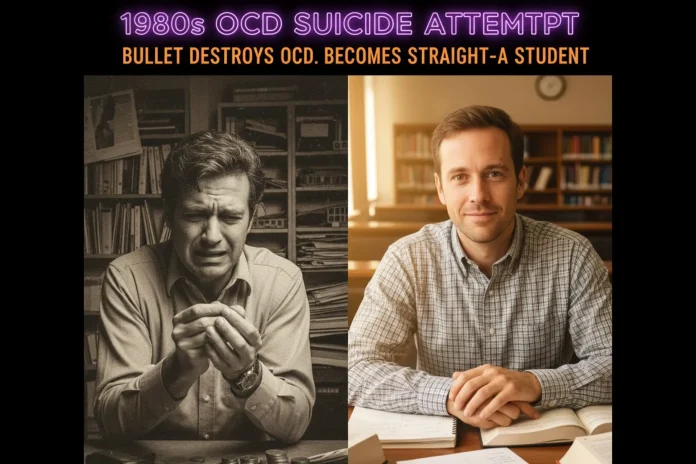
In the early 1980s, a 19-year-old Canadian known in medical reports only as “George” lived in a private hell crafted by severe obsessive-compulsive disorder. Once a bright, straight-A high school student with a promising future, George had been overtaken by an overwhelming phobia of germs that consumed every waking hour. He would scrub his hands hundreds of times a day until his skin cracked and bled, and showers stretched into exhausting marathons—sometimes lasting hours—as he repeatedly cleansed himself in a futile battle against invisible contaminants.
The rituals left no room for normal life: he dropped out of school, quit his job, and withdrew into isolation, his world shrinking to the confines of endless compulsion. Depression shadowed him closely, amplifying the torment until one day, in a moment of raw despair, he confided to his mother that his existence felt so wretched he would rather be dead.
His mother’s response, born perhaps from her own frustration after years of watching her son’s struggle, cut deep.
“So look, George,”
she said,
“if your life is so wretched, just go and shoot yourself.”
The words, later described by his psychiatrist as reflecting the “cruel streaks” sometimes seen in parents of those with severe OCD, landed like a spark on dry tinder. George retreated to the basement of their Vancouver home, retrieved a .22-caliber rifle, placed the barrel in his mouth, and pulled the trigger.
What followed defied all odds. The small-caliber bullet tore upward through the roof of his mouth and burrowed into his left frontal lobe—the very region believed to fuel obsessive behaviors—before lodging there. Surgeons operated swiftly, removing the main slug but leaving behind irremovable fragments. Against every expectation for such a traumatic injury, George survived without detectable damage to his intelligence, memory, or personality.
Pre-injury tests, including IQ assessments conducted during his prior treatment, provided a rare baseline: post-surgery comparisons showed no losses whatsoever on even the most sensitive measures of brain function.
The transformation unfolded like a medical miracle wrapped in tragedy. Just three weeks after the attempt, when George was transferred to Shaughnessy Hospital for psychiatric care under Dr. Leslie Solyom—who had treated him for over a year beforehand—his psychiatrist noted that he “had hardly any compulsions left.” The relentless hand-washing and showering rituals had evaporated almost entirely. Depression lingered and required medication, but the OCD’s grip had been shattered by the bullet’s precise, accidental path—a fluke one expert called “quite remarkable, but not beyond belief,” likening it to rare surgical procedures that deliberately target the frontal lobe as a last resort for intractable cases.
Five years on, George’s life bore little resemblance to his former prison. He finished high school, held down a steady job for the first time, lived independently (though he remained a somewhat lonely figure who visited family occasionally), and excelled as a second-year college student. Minor quirks persisted—closing a window twice to be sure or rinsing a plate extra thoroughly—but they were faint echoes, nothing that disrupted his daily routine.
Dubbed “successful radical surgery” in wry medical circles, the case offered profound insights into OCD’s neural roots, paving the way for modern, safer interventions like deep brain stimulation.
George’s story is a haunting blend of horror and hope: a young man pushed to the brink by untreated mental illness, saved not by design but by sheer chance that rewired his brain for freedom. It underscores the desperation that severe OCD can inflict—and the extraordinary resilience of the human mind when fate intervenes in ways no doctor could plan.