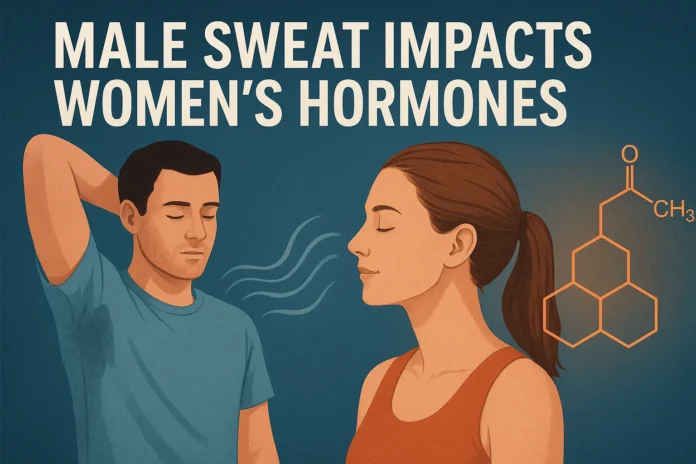
A growing body of scientific research has revealed that male underarm sweat carries chemical signals that regulate women’s hormones, alter menstrual cycles, and even boost mood. At the center of this discovery is androstadienone, a testosterone-derived compound found in high concentrations in male sweat, saliva, and other secretions.
Women are significantly more sensitive to androstadienone than men, with some showing heightened sensitivity levels. Its effects extend beyond the nose, exerting measurable physiological changes in hormone regulation, stress response, and emotional state.
A landmark study by George Preti at the Monell Chemical Senses Center, published in Biology of Reproduction, demonstrated that male underarm secretions can directly influence women’s luteinizing hormone (LH) activity. LH plays a vital role in menstrual cycle timing and fertility.
Researchers found that exposure to male sweat shortened the time between LH pulses by about 20 percent—from 59 to 47 minutes—suggesting that pheromones may subtly regulate reproductive physiology.
Other studies indicate that androstadienone exposure elevates cortisol, the body’s primary stress hormone. Research led by Claire Wyart at UC Berkeley showed that as few as 20 inhalations of the compound raised cortisol levels within 15 minutes, with effects lasting more than an hour.
Interestingly, this hormonal response coincided with improved mood, increased relaxation, reduced tension, and greater sexual arousal—effects that occurred even when participants were unaware they were inhaling male compounds.
Cycle and Context Dependence
The impact of male sweat varies depending on where a woman is in her menstrual cycle. Women in the mid-luteal phase tend to show stronger stress reactions. In contrast, those in the periovulatory phase demonstrate heightened positive arousal and stronger hypothalamic responses—potentially linked to sexual motivation.
In some studies, mood improvements were only recorded when a male attendant was present, highlighting that pheromones may work in concert with social cues rather than acting as automatic triggers.
Potential Medical Applications
These findings open the door to possible clinical uses. Researchers suggest that synthetic chemosignals could one day be used to:
- Treat low cortisol conditions such as Addison’s disease
- Help manage ovulation timing or alleviate premenstrual syndrome (PMS)
- Influence mood regulation in therapeutic contexts
Rigorous Testing and Scientific Significance
The research behind these conclusions employed carefully controlled methods. Male volunteers abstained from deodorant use for weeks, while their underarm secretions were collected and applied to unsuspecting female participants—some of whom believed they were smelling alcohol or perfume. Hormone levels and mood states were measured throughout.
The studies mark the first direct evidence that human chemical signals can affect hormonal balance and psychological states, reinforcing that, like other mammals, humans may subtly rely on chemosignals to influence one another.
While debate persists over the existence of human pheromones—partly due to the absence of a functional vomeronasal organ in adults—this research underscores that chemical communication through the olfactory system may play a more critical role in human interaction than previously thought.