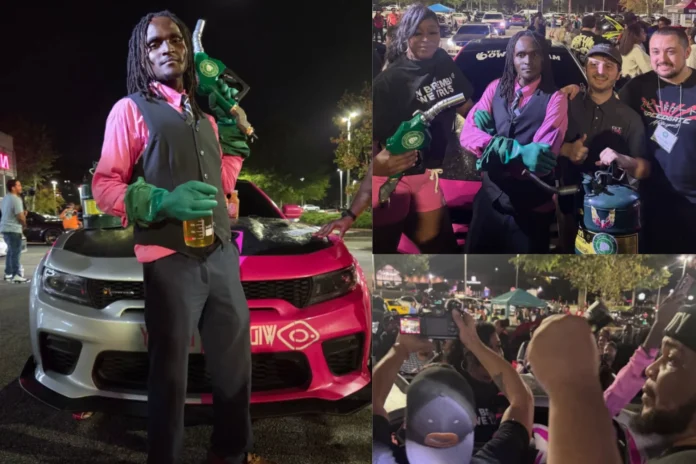
On October 4, 2025, more than 1,000 spectators gathered in Atlanta to witness what could become a defining moment in clean energy innovation. Julian Brown, a young inventor from Alabama now based in Atlanta, successfully powered a 2023 Dodge Scat Pack entirely on PLASTOLINE, a fuel made from converted plastic waste.
The demonstration marked the first known instance of a vehicle running exclusively on a fuel derived from waste plastic through solar-powered microwave pyrolysis, a process Brown developed over five years of research under his company, Jab’s Pyrolysis & Energy Recovery, and brand NatureJab.
Brown’s PLASTOLINE fuel is created by heating plastic waste in the absence of oxygen using microwave energy powered by solar panels. This breaks the material down into usable fuels such as gasoline, diesel, and jet fuel. The approach, he claims, could make the process carbon-negative. PLASTOLINE reportedly boasts a 110 octane rating and burns cleaner than conventional diesel.
“People said it couldn’t be done,” Brown told the crowd during the event. “But today, we turned trash into transportation.”
At just 25 years old, Brown has already built a significant following, with 1.3 million TikTok followers and over 16 million likes on videos showcasing his experiments. His demonstrations — often drawing hundreds to thousands of onlookers — have fueled both admiration and skepticism within the scientific community.
In 2024, Brown suffered second-degree burns when one of his early reactors exploded. He later disappeared from social media amid concerns for his safety after claiming he was “being followed.” His mother later confirmed he was safe and working in private.
Brown has since returned, more determined than ever. Backed by a $100,000 grant from Reddit co-founder Alexis Ohanian and named a 776 Foundation Climate Fellow, he continues to refine his process and expand his company’s capabilities.
Despite the excitement surrounding PLASTOLINE, experts remain cautious. Dr. Andrew Rollinson, an energy engineer, notes that pyrolysis often consumes more energy than it produces, raising doubts about its sustainability. Studies also highlight concerns about toxic byproducts and high sulfur content in plastic-derived fuels — far exceeding traditional gasoline or diesel standards.
Furthermore, while microwave-assisted pyrolysis has been shown to reduce global warming potential by up to 62% compared to conventional methods, its overall carbon footprint remains debated. Burning plastic-derived fuel still emits carbon dioxide, undermining claims of climate neutrality.
Brown plans to continue public demonstrations, with his next event scheduled at a Nissan dealership in Duluth, Georgia. He’s also running a GoFundMe campaign to raise $1 million to construct a full-scale Plastoline plant; as of July 2025, the campaign had raised $18,208.
Despite criticism, Brown’s achievement is a compelling milestone in pursuing sustainable fuel alternatives. Whether PLASTOLINE becomes a scalable clean-energy solution or remains a niche innovation, its success on the streets of Atlanta has already sparked global conversation.
“We’ve seen history today,” one attendee said after the demonstration. “If this works, it could change everything about how we deal with plastic waste.”