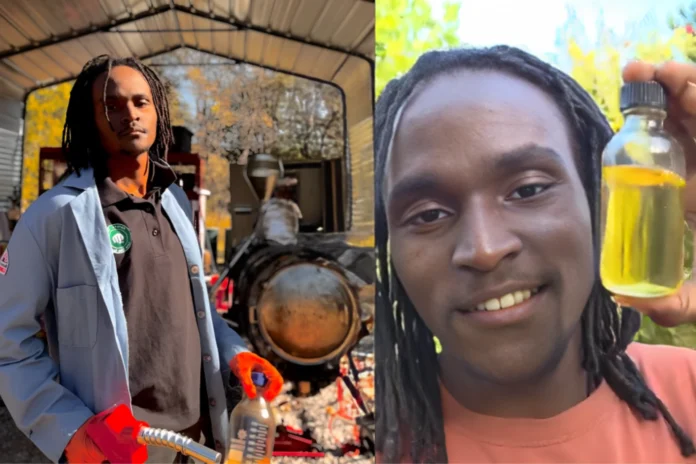
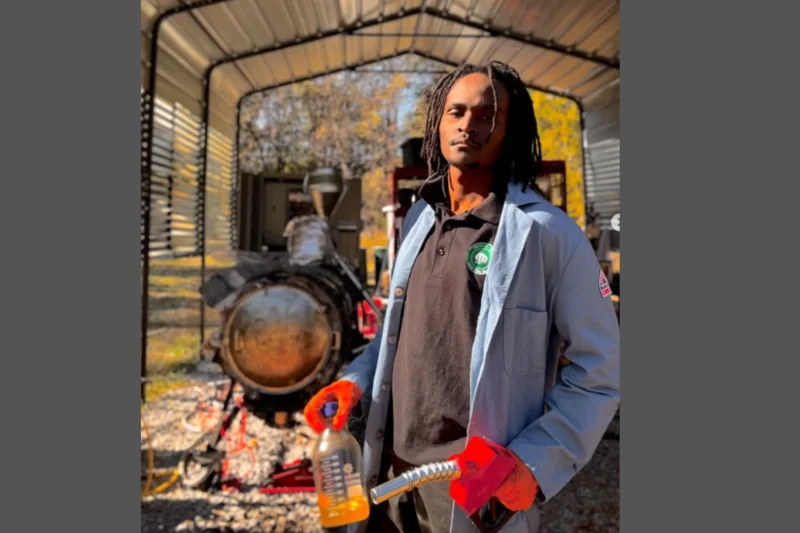
The world produces more than 380 million tons of plastic yearly, yet less than 10% is recycled. The rest piles up in landfills, clogs oceans, and seeps into ecosystems. But amid this mounting crisis, a young inventor from Alabama has developed a groundbreaking technology that could transform the problem into a sustainable solution.
Julian Brown, a 21-year-old self-taught innovator known online as NatureJab, has created a solar-powered microwave pyrolysis reactor that converts plastic waste into clean-burning fuel. His invention, dubbed Plastoline, could simultaneously reduce pollution and provide a renewable energy source.
A 21-Year-Old Genius from Georgia is Turning Plastic Waste into Gasoline.
Brown’s journey began with a simple question: since plastics are petroleum-based, could they be broken back down into fuel? What started as a high school experiment has evolved into his Mark 4.5 reactor, a device that uses 10 microwave magnetrons to heat plastic waste in an oxygen-free environment. The process, known as pyrolysis, breaks plastics into gasoline, diesel, and even jet fuel.
Unlike traditional pyrolysis, Brown’s design uses solar power and heats plastic from the inside out, cutting processing time by 40%. His continuous-feed system allows uninterrupted operation, while a vacuum setup ensures safety and prevents emissions leakage. Each cycle processes about five pounds of plastic into one liter of fuel, yielding an 85% liquid fuel output.
In one live demonstration, Brown fueled a vintage carbureted truck in Houston, Texas, using his Plastoline, which was stored in a paint bucket strapped to the truck’s grill. The innovation has passed diesel certification tests, with analysis at ASAP Labs confirming its viability.
During a demo Q&A, Brown broke it down:
“You see my plastiline right here, gasoline made from plastic waste, 110 octane fuel. Well, let me tell you guys something. For one, no, this does not have any microplastics in it. I’ve had it tested by three different labs, not a single lab found microplastics in this. For two, this is not the same as burning plastic. This is not liquid plastic. This undergoes a permanent chemical change in order to convert it into fuel. And this is a completely separate product from plastic. So burning this in an engine has a completely different effect than burning plastic. And since this has such a high octane, if you have an engine with a high compression ratio, that in return is going to lead to more complete combustion, which leads to cleaner emissions. My machine operates under vacuum, so I’m not burning plastic, and I also don’t have emissions coming from the machine. Anyways, want to figure out how I got the octane rating? Come with me. We have accumulated approximately two and a half gallons of plastic crude oil. Look at that clean and gorgeous blue flame. That’s natural gas made from plastic waste. Plastiline, baby, baby. Woo, 110 octane.”
Collection & Sorting: Plastics like polyethylene (PE), polypropylene (PP), and polystyrene (PS) are separated from contaminants.
Shredding & Cleaning – plastics are reduced into smaller pieces for efficiency.
Pyrolysis Reaction – shredded plastics are heated between 350°C and 500°C without oxygen, breaking down polymers into vapors.
Condensation – vapors cool into liquid fuels, while gases power the system.
Refinement – output is separated into diesel, gasoline-like fuel, and kerosene.
Testing at ASAP Labs, a certified facility, confirmed that Plastoline burns cleaner than conventional diesel. Analysis revealed low sulfur content and carbon chains identical to industry-standard fuel, earning it diesel certification.
Brown isn’t alone in the fight to weaponize plastic waste. Around the world, other inventors are cooking up their own versions of pyrolysis (that’s the fancy term for breaking plastic down into oil and gas at high heat, minus the oxygen).
Philippines: Jayme Navarro in Bacolod can turn one kilo of plastic bottles, bags, or utensils into 900 milliliters of gasoline, diesel, or kerosene.
India: In Kerala, Sreejith Veettil Sreedharan has a small plant that feeds plastic waste into an oxygen-free chamber heated to 400°C. The result? Motorcycle fuel that passes emissions tests.
Ghana: Francis Kantavooro’s setup can reach 900°C, creating gasoline, diesel, kerosene, and domestic gas while employing over 150 people in northern Ghana.
Lower emissions: 28–31% fewer than incineration, with projections up to 65% by 2030.
Waste diversion: reducing landfill use and ocean pollution.
Energy recovery: reclaiming embedded petroleum energy from plastics.
Carbon neutrality: solar integration keeps production net-zero.
Commercial players like RES Polyflow are already scaling the concept, processing 100,000 tons of waste annually to produce 18 million gallons of fuel.
And it’s not just solo inventors anymore. Companies are scaling up:
Beston Group says they’ve doubled efficiency using catalytic pyrolysis.
Sparta Group & Phoenix Canada are converting five tons of plastic into about 4,000 liters of fuel.
RES Polyflow? They’re processing 100,000 tons of waste plastic annually, cranking out 18 million gallons of diesel fuel and naphtha.
The stats are wild: pyrolysis can turn up to 97% of polystyrene into usable oil, with octane ratings that rival premium gas. Emission reductions are 28–31% lower than incineration, with projections suggesting we could cut up to 65% by 2030.
In other words, this isn’t some niche backyard experiment—it’s a legit path toward reducing plastic pollution while meeting global energy needs.
Despite its promise, the technology faces obstacles. High upfront costs, strict fuel regulations, and the technical challenges of handling mixed plastics remain barriers. Still, experts see clear potential.
“Plastic was once considered a waste burden,” said Brown in a recent interview. “Now we can see it as an untapped energy resource.”
A 9-year-old Minecraft and Roblox YouTuber running the channel Mighty Mike Plays (@MightyMikePlays67) ran up roughly $118,000 in YouTube advertising charges on his father's company credit card over about three weeks, according to the father, who said the bill was discovered only when his employer's finance team pulled him into a meeting.
Dave, the father — who identifies himself as David Sarkisyan and works in marketing — laid out the charges in a video posted Tuesday to his son's channel titled "Message from Dad… Mighty Mike Plays is Over." The video opens with 9-year-old Mike introducing himself; when his father...
Goldsboro Police Officer Michael Rivers spent about 45 minutes of his lunch break on March 11, 2020, sitting on the grass beside a homeless woman named Michelle and sharing pizza near a Walmart along 10th Avenue in Goldsboro, North Carolina. Six years on, the encounter has come to be one of the most-shared images of an officer choosing attention over enforcement, and the photo that captured it has continued to resurface in later years.
The 29-year-old officer, then in his ninth year with the Goldsboro Police Department, noticed Michelle standing by a stop sign as he left a Walmart parking...
A young woman born with a congenital limb difference demonstrated the range of motion and dexterity in her hands in a 3-minute, 14-second video shared Saturday by the independent Belarusian news outlet NEXTA.
In the clip, the woman responds directly to a social media comment asking whether she can move her fingers. She appears indoors wearing a brown top and jeans, with red nail polish on her nails, and performs a series of fluid gestures while speaking and smiling at the camera. She interlocks her fingers, points, waves, and carries out precise movements that highlight the function of the digits...
A man dressed as Marvel supervillain Doctor Doom stood behind the podium in the Seattle City Council chamber on Tuesday, Sept. 8, 2026, and thanked officials for expanding the city's surveillance network. The stunt, a piece of deliberate political theater, has turned a Tuesday morning policy meeting into one of the week's most-shared political videos, with video shared widely on X and covered by 404 Media, Gizmodo, and Dexerto.
The council's Public Safety Committee was hearing public comment in the chamber at City Hall, 600 4th Avenue, when the speaker took the microphone in the character's signature silver mask and...