

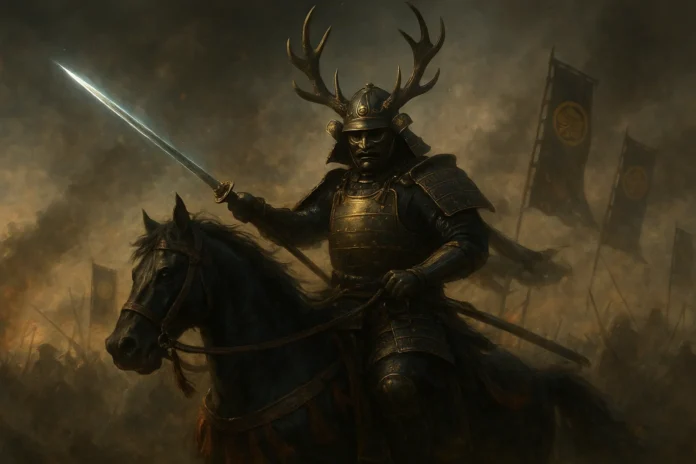
The career of Honda Tadakatsu (1548–1610) initially appears the very stuff of dreams. Here was a man who was reported in the field for more than fifty battles and yet not even once was seriously wounded. To the people of his own time and many a chronicler of today, he seemed practically indestructible a man the records would nickname
“The warrior who defied death.”
Tadakatsu was born in 1548 in the Mikawa Province and at an early age became a vassal of Tokugawa Ieyasu. His loyalty never wavered. From retainers he became one of the foremost generals of Ieyasu and earned a spot in the fabled “Four Heavenly Kings” of the Tokugawa clan along with Ii Naomasa, Sakakibara Yasumasa, and Sakai Tadatsugu.
A tweet from X.
He saw some of the goredest pages of Japan’s Sengoku period the 1570 Battle of Anegawa, the 1575 Takeda confrontation at Nagashino, and the decisive Battle of Sekigahara in 1600 by which Tokugawa’s victory opened the doors for centuries of shogunate rule.
What set Tadakatsu apart wasn’t just his record it was his presence. He rode his black horse Mikuniguro into battle, his lacquered armor gleaming, topped with a helmet crowned by enormous deer antlers. In his possession was the “Dragonfly Cutter,” a razor-pointed spear whose myths insisted a dragonfly would not even be able to perch upon the edge without being sliced in two.
Even his foes like Oda Nobunaga and Toyotomi Hideyoshi are said to have praised him for courage, a praise not easily given in an era wherein one’s loyalties changed as quickly as the tides.
The famous statement of having fought
“57 battles without injury”
Cannot easily be proven and should be approached skeptically at face value by contemporary historians. It was standard for Edo-era chronicles to write in hyperbole for effect, and Tadakatsu’s mythology was not an exception. However, the absence of contradictory documents puts in plain view the fact he was a very fortunate or perhaps very skilled survivor of a half-century at war.
His epic did not end at death in 1610. It instead seems to continue by the day. His armor and spear remain in museums and cultural displays. His burial ground, rediscovered in 1979, is a mute site of memory. His battles continue to be acted out at cultural celebrations. His antlered helmet and spear point persist in video games like Samurai Warriors 5 for new generations.
Four centuries afterwards, Honda Tadakatsu remains a man who constitutes more myth than reality. Or more appropriately, a man who was a perfect marriage of history and mythology. A good vassal, a general who remained unbeaten, or a man blessed by sheer uncommon luck, he continues not just in Japan, but in the imagination of anybody entranced by the timeless nature of the samurai.

