

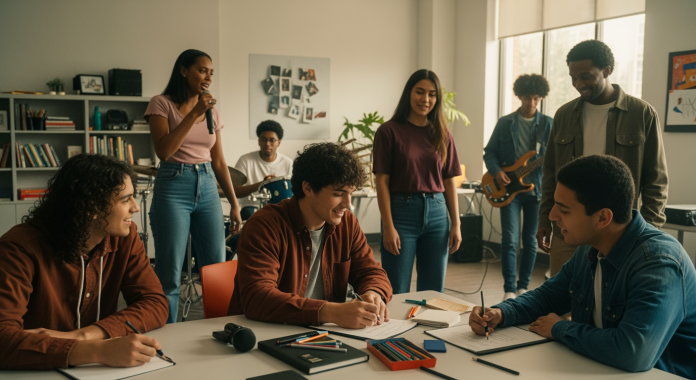
In Chicago, 17-year-old Jamal Jones, who once struggled with truancy and gang involvement, found a new rhythm and purpose. A hip-hop-infused literacy program helped him analyze lyrics, craft verses, and understand the history of his favorite artists. Jamal not only improved his grades but also discovered a powerful voice. His transformation demonstrates hip-hop’s capacity as a transformative force, providing skills that can reshape lives.
This success highlights the growing recognition of hip-hop’s potential beyond music, proving it an effective tool for education and community development. Born from the streets of the Bronx in the 1970s, hip-hop has evolved from a marginalized art form into a global cultural phenomenon. Its core elements—MCing, DJing, breakdancing, and graffiti art—combine with rich storytelling, rhythmic complexity, and social commentary. Together, these offer an unparalleled platform for engagement.
Hip-hop provides a unique lens to explore history, literature, and even complex scientific concepts. This inherent power makes it particularly effective in reaching underserved communities often alienated by traditional educational methods, offering culturally relevant learning experiences. Across the nation, universities are integrating hip-hop into their curricula. The University of California, Berkeley, for instance, offers courses analyzing hip-hop’s impact on political discourse and social movements.
Beyond academia, various organizations utilize hip-hop to teach literacy and history. In New York City, the Hip-Hop Education Center provides fellowships and develops curricula for educators, demonstrating how hip-hop can engage students in subjects from mathematics to science. These programs, active since the early 2000s, show hip-hop as a dynamic method to engage youth in an environment they connect with, moving beyond its role as just music.
Community organizations are also leveraging hip-hop to tackle pressing social issues. Programs in cities like Detroit and Oakland use hip-hop to promote health awareness, prevent gang violence, and encourage political engagement. These initiatives often pair creative expression with critical thinking, empowering young people to become agents of change. For example, some programs teach conflict resolution through songwriting, using rhyme and rhythm to foster empathy and understanding within communities. Such efforts demonstrate how hip-hop can yield significant results and provide safe spaces when applied purposefully.
The success of these programs stems from hip-hop’s inherent didactic qualities. Its cultural relevance and high engagement factor establish it as an effective pedagogical tool. The ability to connect with students on their own terms, use their language, and address their lived experiences fuels the learning process. However, challenges remain. These include securing consistent funding and overcoming institutional resistance. The development of standardized methodologies, replicable and scalable, is also crucial for broader impact.
Looking ahead, hip-hop is poised to become a permanent fixture in holistic education and community building. Its capacity to engage, educate, and empower makes it an invaluable asset in preparing young people for the challenges and opportunities of the 21st century. As more educators and communities recognize its potential, hip-hop will continue to evolve, shaping future generations and contributing to a more just and equitable society. This enduring connection with marginalized communities highlights hip-hop’s power to enact lasting change through these programs.

