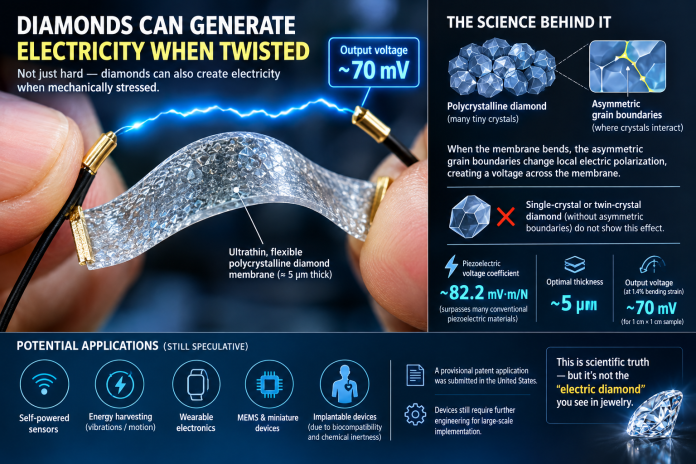
Diamonds have been known for one characteristic for a very long time their hardness. Currently, there is a viral story doing the rounds on the internet, stating that diamonds may perform an even more unexpected feat in addition to hardness: generation of electricity when twisted. To put it briefly, the claim is succinctly stated as follows:
“Not only are diamonds hard, but they can also create electricity.”
The science behind the buzz comes from a peer-reviewed study published March 18, 2026, in Science Advances. Titled “Uncovering piezoelectric effect in polycrystalline diamond membranes” (DOI: 10.1126/sciadv.aea8318), the work was led by University of Hong Kong researchers Professor Zhiqin Chu of Electrical and Computer Engineering and Professor Yuan Lin of Mechanical Engineering.
Piezoelectricity is straightforward certain materials generate an electrical signal when squeezed, bent, or otherwise mechanically stressed. For more than a century, diamond was classified as non-piezoelectric because its highly symmetric crystal structure lacks the built-in asymmetry needed for that response in bulk or single-crystal form. The Hong Kong team changed the form factor. Using an edge-exfoliation technique, they created ultrathin, flexible polycrystalline diamond membranes. These membranes made of many tiny diamond crystals packed together can bend substantially.
The strongest response appeared in membranes about 5 micrometers thick. The study reported a piezoelectric voltage coefficient of approximately 82.2 mV·m/N, a material figure that the researchers note surpasses many conventional piezoelectric materials. Under bending strains up to about 1.4 percent, 1 cm × 1 cm samples produced output voltages around 70 millivolts. The abstract states:
“Our experiments show that the piezoelectricity depends on membrane thickness, with peak response (exhibiting a piezoelectric voltage coefficient of ~82.2 millivolt meters per newton that surpasses many conventional piezoelectric materials) seen in ~5-micrometer-thick membranes.”
This mechanism is related to asymmetric grain boundaries those are the interfaces where those small crystals interact with each other. First principle calculation demonstrated that the deformation of these interfaces changes local electric polarization resulting in the voltage drop across the membrane. It was shown that the similar membranes made of single-crystal or twin-crystal diamond without such asymmetric boundaries do not exhibit any effect. Numerous cycle tests revealed that these signals are consistent and reliable and thus ruled out some artifacts like triboelectric charging.
Future applications are speculative and should be considered only as possible self-powered sensors, energy harvesting through mechanical action or vibrations, wearable electronics, MEMS and other miniature devices and even implantable devices due to diamond biocompatibility and chemical inertness. A corresponding provisional patent application was submitted in the United States. Devices still require further engineering for large-scale implementation.
There is scientific truth behind the viral claim. This is not, however, the “electric diamond” one can see as jewelry stone.