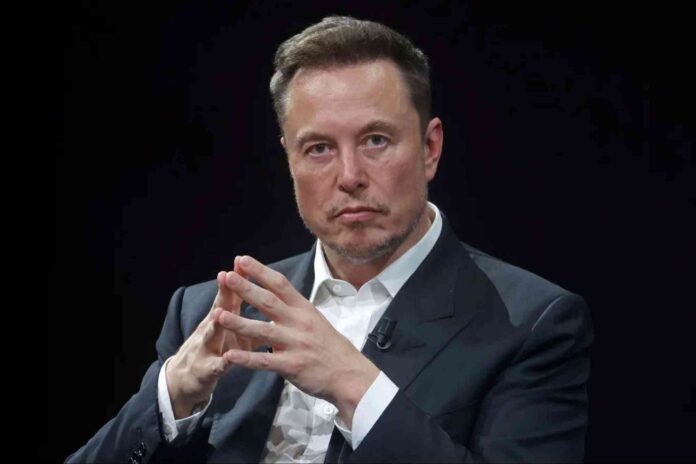
Elon Musk has now claimed that he would no longer allow Apple products into his companies if the tech giant proceeds with its planned integration of OpenAI into its systems. The announcement came on Monday, following Apple’s Worldwide Developers Conference (WWDC), where the company revealed its latest developments, including a new partnership with OpenAI’s ChatGPT.
During WWDC, Apple also demonstrated how ChatGPT will power Siri to make it a better virtual assistant. One demo showed Siri recommending to an iPhone user that they look for ideas for dinner recipes with ChatGPT, and it coupled that with a reminder to validate what the chatbot says. This puts advanced AI integration at a whole new level with Apple devices.
But Musk, reacted quickly to the news through his social networking site, X, by tweeting that the day Apple enables OpenAI at the OS level, he will call on banning Apple devices in all his companies. He went on further to state that at the workplace’s entrance, employees and guests will be expected to check in their Apple products, and the products will be kept in the Faraday cage to ensure security from wireless communications and fields.
Musk perceives this as a massive security threat. He thinks that if it’s merged into Apple’s OS, this AI can absolutely access personal and private details. “If Apple integrates OpenAI at the OS level, then Apple devices will be banned at my company. That is an unacceptable security violation,” said Musk, apparently distressed.
If Apple integrates OpenAI at the OS level, then Apple devices will be banned at my companies. That is an unacceptable security violation.
— Elon Musk (@elonmusk) JUNE 10, 2024
Musk primarily cited privacy as an issue. Even though Apple and OpenAI clearly said that the data would not be forwarded to OpenAI without the owners’ permission, Musk was not convinced. He thinks that the collaboration between OpenAI and OS can lead to an open-ended system that can gather information without proper constraints.
In a series of relentless social media posts, Musk ridiculed Apple, saying the tech giant had to rely on OpenAI for AI technology. “It’s pretty silly for Apple to have to depend on some OpenAI nonprofit for its AI, but somehow be smart enough to ensure with certainty that OpenAI will protect your security & privacy!” he wrote.
It’s patently absurd that Apple isn’t smart enough to make their own AI, yet is somehow capable of ensuring that OpenAI will protect your security & privacy!
Apple has no clue what’s actually going on once they hand your data over to OpenAI. They’re selling you down the river.
— Elon Musk (@elonmusk) JUNE 10, 2024
Musk’s forceful statement caused heated debates among technology buffs. Some experts are, in fact on Musk’s side: OpenAI does endanger personal privacy and data security. The former means that an additional bundle of vulnerability opens up with each additional release of an OpenAI OS.
Conversely, Apple plan backers claim that the current implementation of the ChatGPT app already integrates OpenAI at the OS level. They further argue that the benefit vastly outweighs the risk when users are exposed to enhanced AI capabilities—so long as proper safeguards are in place, together with user consent.
Apple has also listed some benefits such an integration might create. With OpenAI’s ChatGPT integrated at the core of the OS, devices are enabled to be more intuitive, with everyday tasks becoming more accessible and taking less time. A robust and reliable Siri able to generate or summarize text and even carry out intelligent photo editing could be available.
Such integration could further be equipped with collaboration and innovation by integrating human intelligence with superhuman AI. An application related to this case could be found in the games arena, providing dynamically engaging experiences.
All the assurances, however, did little to convince Musk. He’s still lost, wondering, for his life, how Apple can guarantee the security of the data once it brings OpenAI in-house into the OS. “Apple has no clue what’s happening once they hand your data over to OpenAI. They’re selling you down the river,” said Musk .
It has been suggested that to alleviate some of these concerns, a look at some alternatives to OpenAI integration, such as Hugging Face, IBM Watson, Google Cloud AI Platform, and Microsoft Azure AI—all of which feature relatively the same capabilities—could be in order. These alternatives will give reasonably robust AI solutions while potentially reducing some of the security risks that fully integrating into the OS offers.
And it’s bound to be shaded with a subplot explaining some of the dynamics between OpenAI and Musk. He co-founded the artificial intelligence research lab in 2015 with Sam Altman, with the original idea that it would be founded as a nonprofit, one centered on possibly the dangers of artificial intelligence. But those relationships frayed partly because OpenAI turned partly for-profit—an outcome that Musk has since publicly castigated.
In March, Musk filed a lawsuit against OpenAI and Altman for allegedly transgressing the company’s original purpose. In response, Altman immediately put out a cascading series of emails where Musk was found supporting the structure change to a hybrid model. Musk, in one of the correspondences, went ahead to make light of the situation, saying he would drop the lawsuit if the company simply changed its name to “ClosedAI.”
The clash between Musk and Apple highlights the growing tensions around AI integration and data privacy. Whether Musk will follow through on his threat to ban Apple devices remains to be seen, but his stance has undoubtedly stirred a lively debate within the tech community.