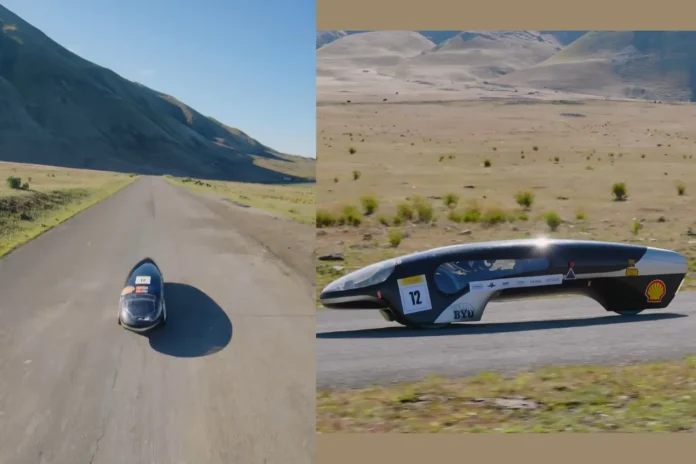
An engineering group at Brigham Young University in Utah shocked the Internet world recently after showcasing an experimental car that runs on only one gallon of gas but can drive up to 2,145 miles. This sensational piece of news went viral on all social media sites, including X, Facebook, Reddit, and Instagram, along with some amazing pictures of this ultra-efficient car.
It holds up under scrutiny. Reports from reliable sources like BYU News, Deseret News, Carscoops, and Interesting Engineering back the result. Built by students, the vehicle called Supermileage was made for the 2026 Shell Eco-marathon Americas event held at Indianapolis Motor Speedway, finishing top in its class while beating close to eighty teams from North and South America. Success came after intense testing and long hours refining every part.
Three times now, BYU has taken first place within a span of four annual events, records confirm. A full test run logged exactly 2,145 miles per gallon when running on ethanol, data shows.
Light as some bicycles, the model weighs only 49 kilograms about 108 pounds and it’s built from carbon fiber. Droplet-shaped, so it slips easier through wind. Drag drops fast because of how it’s built. Only carries 30 milliliters that’s about two tablespoons of fuel. Fits one rider, but only if they’re short, say under five-foot-four, lighter than 120 pounds. Goes fastest at around 23 miles an hour
“The engineers noted that it would take only a single gallon of fuel to drive from Utah to New York,”
One report highlighted, though the car requires frequent refueling due to its tiny tank.
The team achieved this efficiency through smart engineering. They used extreme weight reduction, a streamlined design that cuts air resistance, and a “burn-and-coast” strategy where the vehicle accelerates briefly then coasts to save fuel. Professor Dale Tree, the faculty mentor, noted the vehicle’s low profile and uncomfortable driving position, where the driver lies nearly flat.
For comparison, the average American car gets between 25 and 50 mpg. Even top hybrids rarely exceed 60 mpg combined. This prototype blows those numbers away, but only under strict competition rules on a closed track.
Limitations are significant. The vehicle is not street-legal, offers almost no safety features, and prioritizes efficiency over comfort, speed, or practicality. Critics correctly point out it functions as an engineering demonstration rather than a realistic daily driver.
“The car sits so low that larger vehicles could potentially drive over it,”
Tree explained in team coverage.
BYU Supermileage Club president Camille Nobrega and the roughly 20 student team members focused purely on pushing technical boundaries. Winning brought cash rewards along with a chance to compete worldwide come 2027, hosted under desert skies.
One thing is certain students at BYU pushed limits with their Supermileage car, proving clever design still matters. Not every breakthrough hits showrooms fast, yet ideas born in college labs shape tomorrow’s vehicles. Though gas-powered models fade into background, work like this keeps fuel efficiency debates alive. What counts isn’t speed it’s how far a drop of gasoline can take you. Real progress hides in small steps, not headlines.