

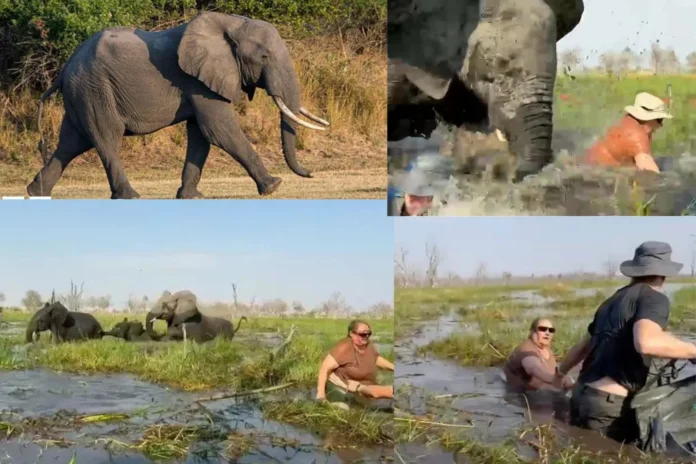
Four Western tourists narrowly escaped death after a bull elephant attacked their safari canoes in Botswana’s Okavango Delta on Saturday, September 28. The terrifying incident, captured on video, shows the massive animal charging the group and forcing one woman underwater for several harrowing seconds.
The victims—two British and two American couples—were on a mokoro safari when their guides steered too close to a female elephant with two calves. In an instinctive act of protection, a nearby bull elephant launched a violent charge.
Video footage reveals the 6-ton animal storming through reeds before striking the two nearest canoes with its trunk, capsizing them and plunging the tourists into crocodile-infested waters. In a particularly chilling moment, the elephant used its trunk to pin one woman beneath the surface for nearly 10 seconds.
“The woman was lucky not to have been gored, but if it had held her down for another few seconds, it would probably have drowned her,” said a former South African game ranger who reviewed the footage. She survived only because the elephant lost track of her in the murky water and broke off the attack.
The group had been traveling in mokoros—traditional dugout canoes now often made from fiberglass. These flat-bottomed boats, steered by skilled polers, are a signature of the Okavango experience, offering visitors an intimate way to explore the Delta’s narrow channels.


Praised for their silence and low environmental impact, mokoro safaris are particularly popular among birdwatchers and wildlife photographers. But the incident underscores the risks of such close encounters with Africa’s largest land mammals.
Experts say the attack was a classic case of protective elephant behavior. Female elephants are known to be fiercely defensive of their calves, and the bull’s aggression was triggered when the canoes ventured too close.
Botswana hosts the world’s largest elephant population—around 130,000 individuals, roughly one-third of Africa’s total. The Okavango Delta, designated a UNESCO World Heritage Site in 2014, provides a crucial habitat for these animals, which weigh up to seven tons and stand more than 12 feet tall.
Though no one was seriously injured, the attack highlights the dangers of wildlife tourism. Elephants kill more than 500 people annually across Africa. A capsized canoe can quickly turn deadly in the Delta, where crocodiles and hippos lurk in the waters.
Tourism staff confirmed the group lost expensive cameras and phones in the attack, but escaped without significant injuries. “It is a blessing nobody was badly hurt, but wild animals can be unpredictable,” said a tour company receptionist.
This is not an isolated case. Earlier this year, a female elephant killed two tourists—one British, one New Zealander—in Zambia after charging their vehicle. With growing elephant populations and expanding tourism, encounters are becoming more frequent and sometimes deadly.
Experts say the Okavango incident is a sobering reminder of the dangers. “This was a very lucky escape,” one ranger noted. “It underlines the need for strict safety protocols and the importance of giving elephants the space they require.”

