

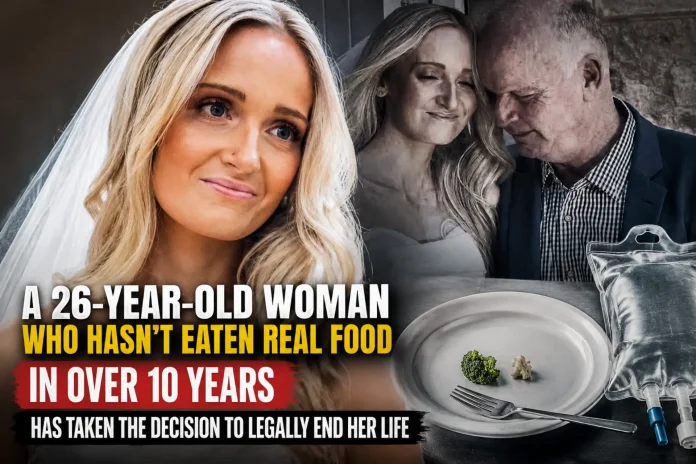
In Adelaide, Australia, 26-year-old Annaliese Holland, who has not consumed solid food in more than ten years, has made the decision to legally end her life through voluntary assisted dying (VAD). She lives with autoimmune autonomic ganglionopathy (AAG), a rare and incurable condition in which the immune system attacks the autonomic nervous system. The disease has paralyzed her stomach and intestines, forcing her to rely on total parenteral nutrition (TPN) delivered through intravenous drips for every calorie and nutrient her body needs. Her choice closes a decade-long battle with an illness that began in childhood and worsened sharply after her diagnosis at age 18, leaving her in constant pain, nausea, vomiting, and repeated life-threatening complications.
Holland first experienced severe illness around age 12, but it took six years for doctors to identify AAG as the underlying cause. Since her early teenage years, she has subsisted solely on TPN delivered via IV drips because her body cannot digest or absorb any solid food. She has endured more than 25 episodes of sepsis, multiple organ complications, dozens of daily injections, and frequent hospitalizations. Verified medical records confirm the disease has stripped her of basic bodily functions, forcing her into a relentless cycle of surgeries and treatments with no hope of recovery.
The condition confines her to her bed or couch for up to 17 hours a day. The IV bags that sustain her life require frequent changes and constant sterile care to prevent deadly infections, a routine she has carried out on her own for years with the help of visiting nurses.
Following extensive assessments, including psychological evaluations, Holland received approval for voluntary assisted dying under South Australian law. She describes the option as a “safety blanket” that restores a sense of control after her body’s prolonged betrayal. Dr. Chloe Furst, a dual-trained geriatrician and palliative care physician who serves as South Australia’s VAD clinical advisor, will oversee the self-administered process, which meets the strict eligibility criteria of terminal illness and mental capacity. Holland has explicitly stated her desire to die on her own terms, rather than face a slow decline from organ failure or another infection. She has spoken openly about how the choice empowers her, after initial resistance from both herself and her family.
In her remaining time, Holland is fulfilling a personal list of meaningful final experiences, which she calls her “f**k it list.” The list includes wearing a wedding dress for photographs with her father, Patrick, a moment captured earlier this year at an Adelaide bridal studio. She also hopes to hold a newborn baby, take a helicopter ride, and host a celebration of life with family in place of a traditional funeral. Recently shared public images show her in an elegant white gown embracing Patrick in an emotional outdoor scene that conveys both joy and bittersweet tenderness, with tears visible on his face as he bows his head. Her mother, Armanda, and an unnamed sister have provided quiet strength throughout her journey, as she focuses on creating lasting memories.
Holland has used her public platform to speak candidly about living with terminal illness and the importance of open conversations regarding end-of-life choices. Her Instagram account, where she directly shares updates with supporters, has grown to more than 44,000 followers and features personal videos detailing her daily realities. Her late friend, Lily Thai, who also lived with AAG and chose voluntary assisted dying in 2023, inspired Holland to consider the same path after she held Thai’s hand during her final moments. Public discourse around her story has underscored the human impact of rare diseases on young adults and the vital role of legal safeguards in providing dignity.
South Australia implemented voluntary assisted dying on 31 January 2023, following passage of the Voluntary Assisted Dying Act 2021, which sets out clear protocols for assessment and administration. Holland has expressed gratitude for the framework that allows her this choice, while also advocating for greater awareness for others facing similar struggles. Her narrative highlights how such laws can offer peace to individuals whose suffering has no medical resolution in sight.
The case prompts reflection on the balance between preserving life and honoring individual autonomy when pain becomes unremitting. At only 26, Holland represents a growing demographic of younger patients who qualify for voluntary assisted dying, yet whose decisions spark broader societal questions about youth vulnerability and medical ethics. Her courage in documenting her process and fulfilling her final wishes demonstrates remarkable resilience amid profound loss. As she prepares for her chosen farewell, her focus remains on creating lasting memories for loved ones and championing compassionate end-of-life options. Her journey serves as a poignant reminder that behind every statistic is a person seeking dignity on their own terms.
For those who want to follow her updates directly, her personal account is available at @annaliese_holland on Instagram. Additional background on her story appears in ABC News Australia’s March 2026 feature interview with Annaliese Holland and local reporting on her wedding dress moment.

