

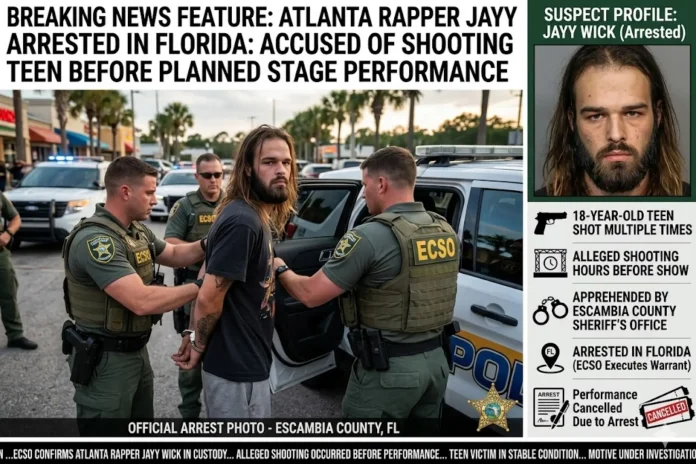
Atlanta rapper JaYy Wick, whose real name is Donald Anderson, faces a charge of attempted first-degree murder after authorities say he shot an 18-year-old multiple times at Beach Access 83 in Panama City Beach, Florida, on April 25 before performing later that night at a local nightclub.
Anderson, 26, allegedly opened fire on the victim around 11 p.m. that Saturday evening. Deputies responded to reports of the shooting and found the teenager suffering multiple gunshot wounds. The victim, who knew Anderson and had traveled with him from Georgia, survived after undergoing treatment for his injuries.
After the incident, Anderson left the beach area and went on to perform as scheduled at Vibez Night Club in Panama City. Law enforcement described him as continuing his plans without interruption. Investigators pursued leads across state lines and obtained a warrant for his arrest. On May 5, a multi-agency team including the Bay County Sheriff’s Office, Panama City Beach Police, U.S. Marshals Service, Atlanta Police, and Clayton County authorities took him into custody without incident at Southlake Mall in the Atlanta area, specifically in the food court near America Deli. Body camera footage shows officers approaching Anderson as he stood calmly near a table with drinks. He complied immediately as handcuffs were applied, with a firearm recovered from him during the process.
The coordinated cross-state effort underscores how quickly modern law enforcement can close in on suspects who flee jurisdictions after violent incidents. Anderson, originally from the Cordele area in South Georgia and known for tracks such as “Pork Chop Sammich,” had built a following as an independent artist with recent momentum in the scene. His calm demeanor during the recorded arrest drew significant online attention and commentary.
This incident fits into a broader pattern of legal troubles involving rappers, particularly in Florida. The state has seen repeated high-profile cases in recent years, from drug trafficking and weapons charges against artists like Kodak Black to gang-related sweeps and fraud arrests involving South Florida performers. Panama City Beach and other tourist-heavy coastal areas often become flashpoints when out-of-town visitors mix with nightlife, where disputes can escalate rapidly. These trends reflect both the visibility of hip-hop figures and the aggressive pursuit by Florida agencies that use multi-jurisdictional task forces and digital evidence to secure convictions.
The case raises pointed questions about personal accountability for emerging artists who maintain performance schedules amid serious allegations. While Anderson is presumed innocent until proven guilty in a court of law, the charges carry a potential minimum sentence of 25 years if convicted. He awaits extradition to Bay County, where the investigation remains active. Public reactions range from shock at the alleged sequence of events to debates over his background, the victim’s relationship to him, and the speed of the arrest.
Court records and official updates will provide further clarity as the case proceeds. Readers can review the Bay County Sheriff’s Office announcement for primary details on the arrest and charges. Additional context on Anderson’s music career appears on platforms where he has shared his work.

