

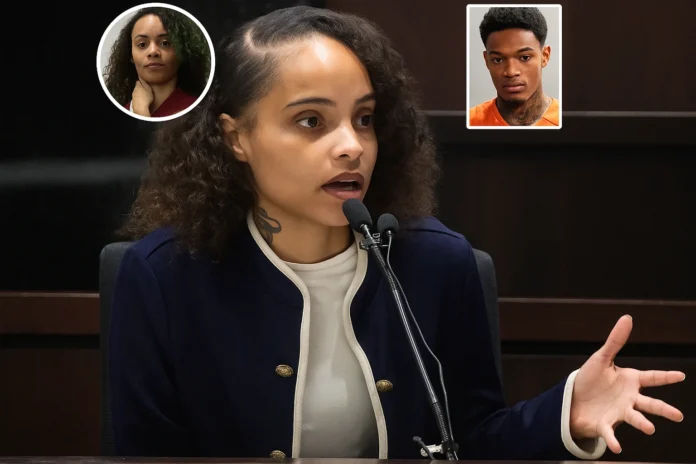
A Tampa jury on Thursday found 22-year-old Alicia Andrews guilty of manslaughter—a lesser charge than the original count of first-degree murder—in connection with the June 2024 killing of Jacksonville rapper Julio Foolio (real name Charles Jones). The verdict was reached on October 31, 2025, after about three and a half hours of deliberation. Jurors also acquitted Andrews of conspiracy to commit murder.
Andrews faces up to life in prison without parole and will be sentenced on December 8, 2025.
Prosecutors sought to portray Andrews as a willing participant in the crime and later as someone who maintained intimate contact with her co-defendant, Isaiah Chance, while both were jailed awaiting trial. Phone and jail kiosk records showed that Andrews and Chance spoke multiple times a day, with messages that prosecutors described as “sexting.”
During her October 30 testimony, Andrews acknowledged maintaining contact with Chance. Under questioning by Hillsborough County Assistant State Attorney Michelle Doherty, she admitted:
“Yeah, he do. I keep him happy, like I said.”
When pressed about her motivation, Andrews said:
“I’m doing what I have to do. I’m not gonna let him know. I’m not gonna get on the phone and act like it’s a change. I’m acting the same. I’m doing what I have to do.”
Prosecutors used this to argue that Andrews’ ongoing contact with Chance undermined her claims of fear and detachment. Doherty questioned her about whether she was still in a relationship with him:
“You are claiming to this jury that you’re not in a relationship with him anymore. Is that true, ma’am?”
“I’m not,” Andrews replied. “I said he may think that because I never broke up with him. But I’m not.”
Andrews went on to explain that she continued communicating with Chance because she feared retaliation, even from inside the jail.
“I don’t want to cause any safety issues in his jail,” she said. “He sends me verbal messages where I’m at… Like, it’s safety issues. Like, literally before I came to trial, a deputy told me one of my co-defendants was trying to have me jumped.”
When Doherty pressed that Chance “is locked up for first-degree murder charges and cannot get to you,” Andrews insisted,
“You do know his ways in a jail… You can send messages to people.”
She admitted using three-way calls through Chance’s mother to circumvent jail policy:
“Yeah, we do that. … When he asks for me, I do it.”
Andrews said she called him “five to ten times a day” and exchanged messages about their case and personal matters.
“If he wants me to call, if he wants to talk to me, let him know about the baby… I let him know I’m okay. That’s what I do.”
“I’m not going to get on the phone and act like it’s a change,” she added. “I’m acting the same. I’m doing what I have to do.”
Throughout the trial, Andrews maintained that her communication with Chance was motivated by fear, not affection. She told jurors she worried for her safety even while behind bars.
“You can get in a fight at any time,” she testified. “All of them [deputies] don’t do their job, also.”
Andrews said she feared Chance could still orchestrate violence against her through others, recounting an incident where a deputy warned her that one of her co-defendants “was trying to have [her] jumped.”
Prosecutors, however, argued that Andrews’ claim of fear was inconsistent with her repeated and voluntary contact with Chance. Doherty emphasized this contradiction, asking:
“And you call him multiple times a day, every day, for several months. Isn’t that true?”
Andrews confirmed, “Yes… I’m doing what I have to do.
The defense argued that Andrews was a victim of domestic abuse, claiming that Chance’s control and violence left her emotionally and psychologically manipulated. Andrews’ best friend testified that Andrews had sent photos and texts showing injuries from alleged assaults. In one February 2024 text message read in court, Andrews wrote that Chance “almost killed me.”
Defense attorneys also described Chance as “extremely controlling,” restricting Andrews’ clothing choices, social media activity, and even smashing her phones.
But Judge Michelle Sisco ruled before trial that evidence of domestic violence would not be admissible. Under Florida law, defendants charged with premeditated murder cannot use duress as a defense—rendering such evidence legally irrelevant.
Prosecutors alleged that Andrews played a support role in tracking Foolio before his killing. They claimed she and Chance followed him in a silver Chevy Cruze, serving as “cover” for a second vehicle—a black Chevy Impala carrying three masked shooters.
In closing arguments, the state described Andrews as “a trusted confidant of her boyfriend, Isaiah Chance.” Cell tower records placed her near several scouting locations before the ambush.
However, the defense countered that no direct evidence—such as texts or calls—linked Andrews to planning the murder. She was never seen with a weapon, did not attend key meetings, and had minimal interaction with other defendants besides Chance.
Andrews told jurors she believed she was on a romantic outing with Chance and denied knowing about any murder plot.
“I mean, I heard a lot of shots, so I didn’t know what went on—shooting in the air, somebody got shot at, I didn’t know,” she testified.
She admitted lying to police during interrogation, saying it was out of fear of her co-defendants. She denied ever seeing a gun or hearing any plan to kill Charles Jones, claiming she only learned of Foolio’s death through social media.
Prosecutors also confronted her with a 2021 text message where she said Foolio “needed to die.” Andrews told jurors she was 17 at the time and “just gossiping.”
Julio Foolio was killed on June 23, 2024, outside a Holiday Inn near the University of South Florida while celebrating his 26th birthday. Authorities say the ambush was tied to a gang rivalry involving Foolio’s group, 6 Block, and rival gangs ATK and 1200.
Five people were charged: Andrews, Chance, Sean Gathright, and brothers Davion and Rashad Murphy. Prosecutors allege Gathright and the Murphy brothers were the gunmen. Their trials are expected in spring 2026.
The Hillsborough County jury began deliberating at 6:50 p.m. Thursday and reached a verdict by 10:20 p.m., declining Judge Sisco’s offer to reconvene the following week.
The decision—convicting Andrews of manslaughter rather than first-degree murder—suggests jurors believed she played a role in the events surrounding Foolio’s killing, but without intent to kill.
Andrews is currently being held without bond at the Hillsborough County Jail pending her December 8 sentencing.

