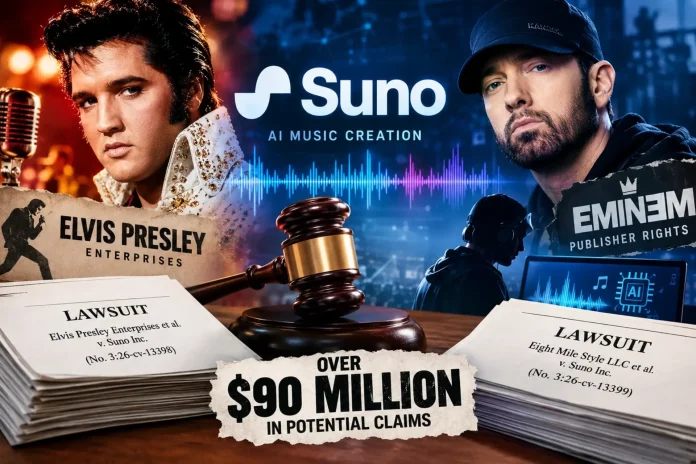
In fact, two of music’s most important traditions have just fallen right into the middle of the AI copyright battle. On November 6, 2026, the copyright owners associated with both Elvis Presley and the publisher of Eminem filed lawsuits in the U.S. District Court of Northern California against the AI music creation company Suno. The total amount of potential claims is over $90 million.
The cases are Elvis Presley Enterprises et al. v. Suno Inc. (No. 3:26-cv-13398) and Eight Mile Style LLC et al. v. Suno Inc. (No. 3:26-cv-13399). Both were filed the same day by the same legal team. These remain allegations only. Nothing has been proven in court.
Eight Mile Style and Martin Affiliated control rights to 269 Eminem compositions. The complaint names hits including “Lose Yourself,” “Stan,” “Without Me,” “The Real Slim Shady,” and “’Till I Collapse.” Plaintiffs say Suno used the works without permission to train its system and that the platform generates outputs with lyrics and musical elements that closely track the originals.
They seek statutory damages of up to $150,000 per work for alleged willful infringement, totaling about $40.35 million, plus additional amounts tied to claimed removal of copyright management information. Reports put the overall demand north of $41 million. Eminem himself is not a named plaintiff. The publisher is acting on the catalog it administers.
The Presley side involves Elvis Presley Enterprises, Authentic Brands Group entities, Raleigh Music Publishing, and other rights holders. They allege copyright infringement involving hundreds of works and, more pointedly, unauthorized commercial use of Elvis’s voice and likeness.
The “Ensuring Likeness Voice and Image Security Act” ELVIS Act, 2024 of Tennessee is precisely at the core of the claim. It is aimed at preventing AI cloning of voice, image, and likeness of a person without obtaining authorization from the owner in order to use them for commercial exploitation. Suno, the plaintiff states, allows its users to create musical tracks that reproduce the unique voice of Elvis Presley without obtaining a license. This case is turning out to be one of the first practical applications of the act.
Suno denies wrongdoing. A company spokesperson said:
“Suno exists to help people create new, original music, not to trade on anyone’s name or likeness, and we prohibit any unauthorized use of an artist’s work. To protect against this, we do not allow prompts for specific artists’ names and songs and work with third-party providers to screen uploaded audio files and lyrics for potential misuse. We are always working to strengthen our guardrails.”
However, plaintiffs argue that such stylistic prompts can lead to comparable outcomes despite the presence of name filters. The litigation is expected to revolve around the training data, similarity of the output to the protected works and whether the ELVIS Act applies to the platform.
These new filings join a growing pile of litigation targeting Suno and other AI music products initiated by leading record labels, publishers, and artists. The issues at stake include the possibility for the companies to train generative models on their copyrighted collections without obtaining the licenses from the right holders. Moreover, can outputs mimicking the famous voices and lyrical style infringe on the copyright law and require compensation of the artist or their heirs?
The viral post about the “over $90 million” claim of the plaintiffs correctly states the amount of potential damage claimed in the separate lawsuits. It is neither one judgment nor one suit but rather the sum of possible statutory damages in case the plaintiffs win. It will be up to the courts to determine the facts.
For musicians, publishers, and AI companies, the decisions in these two test cases could have implications on the future licensing and product development processes.