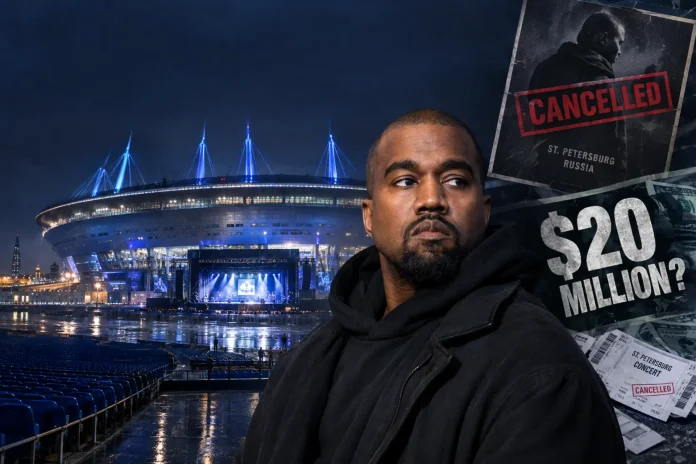
Kanye West, who goes by Ye, was set to play two massive shows in St. Petersburg this weekend. Those plans fell apart. Now a disputed report claims he walked away with roughly $20 million and may not have to give any of it back.
Say Agency, the Moscow promoter led by Anna Subcheva, announced the October 10 and 11 dates at Gazprom Arena back in mid-August. Tickets priced from about 9,000 rubles to 160,000 rubles moved fast. Organizers said more than 100,000 sold in the first two days. The shows would have been among the biggest Western artist appearances in Russia since 2022.
Politically charged atmosphere started right away. Russian authorities and activists drew attention to the antisemitic remarks of Ye and Nazi symbols used by him, which conflict with the law that prohibits the glorification of Nazism. Spokeswoman for the Foreign Ministry of Russia Maria Zakharova described the planned events as unacceptable. There was even a call to publicly back the Russian army in Ukraine from some politicians.
But soon the venue intervened. In late August, Gazprom Arena stated it had not entered into any contract and therefore the concerts would not take place. The Say Agency denied it, referring to the letters of permission and the draft of the contract. Confusing statements went on for several weeks.
The concerts were removed from the schedule of Ye’s tour by late September. His U.S. agency Access Opera informed that the shows were cancelled and directed the buyers of tickets to Say Agency. The concert promoter officially cancelled the concerts on September 30, offering its “sincere regrets” and refunding the tickets starting from October 12. Nine lawsuits were filed by the fans requesting the return of money. Fraud investigation was launched by St. Petersburg police department.
Kommersant, a Russian financial newspaper, reported on October 8, citing anonymous sources with knowledge of the negotiations, that Ye was paid about $20 million. This money was meant to be for his entourage and the cost of production but not for him personally and, importantly, without any need for refunding once the contract was cancelled. Subcheva dismissed the $20 million as “absolutely false.” She argued that the financial damage to the company was moderate and that no laws were violated.
Dozhd, an independent Russian news source, accused two promoters, Nadezhda Solovyova and Yevgeny Finkelshtein, of competing against each other and using their connections with the FSB to stop the events from taking place once the contract was cancelled because they lost the bidding. However, there is nothing to confirm this information.
No single official reason for the cancellation has been confirmed. The refund process is scheduled to begin soon. The $20 million payment and any non-refund clause rest on anonymous sourcing and are denied by the promoter. Settling the money question would require the actual contract, bank records, court filings, or a direct statement from Ye or his representatives. Until then the central financial claim stays reported but disputed.