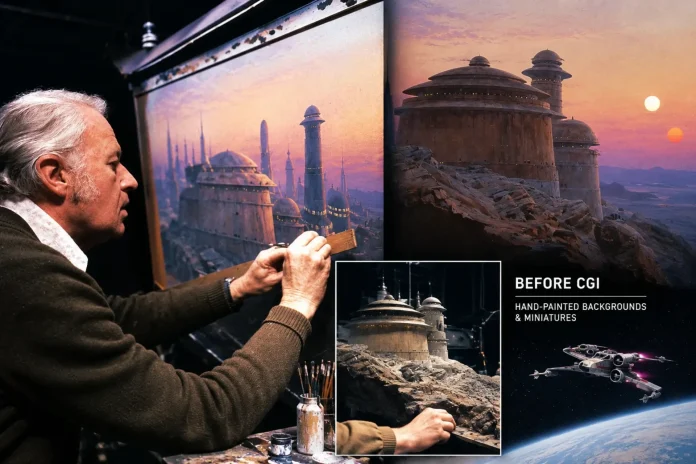
Before pixels ruled the screen, Star Wars built its galaxy the old-fashioned way: with brushes, glass, and a whole lot of patience.
Long before CGI became the default language of blockbuster filmmaking, the original trilogy relied on a nearly lost art form—matte painting. Artists at Industrial Light & Magic spent weeks, sometimes months, hand-painting entire worlds onto large sheets of glass and plexiglass. Those paintings were then optically blended with live-action footage so seamlessly that audiences rarely noticed the join. The result felt tangible, weighted, and strangely real in a way that still holds up nearly five decades later.
The process was exacting. Crews would shoot actors on partial sets, deliberately leaving sections of the frame black or incomplete. Matte artists then filled in the missing architecture, landscapes, or starship docks, matching perspective, lighting, color temperature, and even the characteristics of the original camera lens. The final composite was re-photographed so the painted elements and the live-action plate appeared continuous. Rear projection, bi-pack techniques, and careful optical printing did the rest.
Ralph McQuarrie, the visionary concept artist who essentially invented the look of Star Wars, contributed both the foundational production paintings and actual matte work. Harrison Ellenshaw handled the bulk of the roughly 17 matte shots in A New Hope. Michael Pangrazio stepped up to supervise the more extensive matte work on Return of the Jedi, joined by Chris Evans and Frank Ordaz. Between them, they created hangars that seemed to stretch forever, Hoth vistas that blended seamlessly with Norwegian location footage, and Cloud City exteriors that still look impossibly elegant.
In the Death Star hangar of the first film, only part of the Millennium Falcon was a physical set. The rest was painted or photo-matched. The reactor shaft gained its dizzying depth the same way. By Empire and Jedi, the technique had expanded: vast Rebel docking bays filled with ships and personnel, ranks of stormtroopers stretching into the distance, and planetary landscapes that felt lived-in rather than rendered.
What made these shots special wasn’t just technical precision. The paint itself carried texture. Distant elements were often kept looser and more suggestive because the human eye accepts less detail at range. That painterly quality actually helped the illusion. Real oil and enamel on glass matched the grain and organic feel of the film stock and the practical models in a way early digital work sometimes struggled to replicate.
Many of the original glass paintings were later cleaned and reused for other projects, so few survive intact. One well-known Jedi docking-bay painting was reportedly done on a piece of glass bought from a hardware store. The craft was that hands-on.
Digital tools eventually replaced the glass sheets, and by the prequel era CGI had largely taken over. Yet the original trilogy’s hand-painted approach remains a high-water mark for practical effects. It didn’t just solve production problems—it gave the galaxy a physical presence that still feels distinct.
In an age of infinite digital possibility, those carefully brushed vistas are a reminder that sometimes the most convincing worlds are the ones someone actually painted by hand.