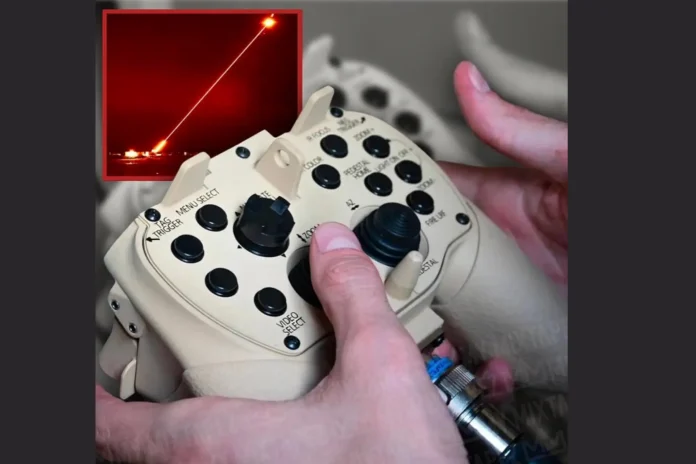
A photograph of a tough, button-laden military device which resembles an Xbox controller in appearance has been circulating, accompanied by stories about how American troops are using it to shoot high-energy lasers at targets in the Strait of Hormuz. The internet version estimates that the device costs $2,200 and is taking out drones and cruise missiles. This is what the reporting reveals.
The New York Post reported on September 24 that the Department of War confirmed lasers are being used in the Strait of Hormuz against drones and incoming cruise missiles at a fraction of the cost of traditional interceptors. Operators run the systems with reconfigured Xbox-style controllers. Secondary coverage from outlets including CNBC TV18, UNILAD, and The Economic Times has repeated the account.
This is a directed energy weapon. It converts electrical power generated by ships or vehicles into infrared energy beams, which are invisible to the naked eye. The person controlling the device keeps it focused on the target for a few seconds in what is known as the “dwell time” until sensors stop working, metal melts, or the target disintegrates. The cost per shot comes down to a few dollars worth of electricity instead of hundreds of thousands in missile costs.
Ship-mounted systems such as Lockheed Martin’s HELIOS (roughly 60-kilowatt class, integrated with Aegis) are the ones linked to the Hormuz reporting. On the Army side, AeroVironment’s LOCUST family has moved into production under a roughly $465 million contract awarded in early September for “war-ready” systems aimed at drones. Similar technology has already been used along the southern border against cartel drones.
Why a gaming-style controller? The gaming industry already solved the ergonomics problem. Many younger service members already know the layout, so training time shrinks. Jared Keller of the Laser Wars newsletter put it bluntly: “The video games industry figured out what the best controller was and now the US military is saying, ‘Well, why reinvent the wheel with a specialized control system where you can just use an Xbox controller or something really similar to do the job?’” Mark Neice of Directed Energy Consultants added that operators can put the spot exactly where they want it to disable sensors or destroy the target.
In June, Secretary of War Pete Hegseth took a controller at White Sands Missile Range and brought down a drone after only a couple of minutes of training, according to the same reporting. The military has used Xbox-style interfaces for years on drones, robots, remote weapon stations, and even submarine photonics masts. The units in the field are militarized and ruggedized versions, not retail controllers pulled off a store shelf.
However, the exact amount of $2,200 that is used in the viral post is not found in the New York Post article or any other article. However, there is mention of such full-motion control units in the price range by some people on the internet but is not yet validated in any of the main reports. The claims of cruise missile strikes that were verified by the New York Post in the Department of War are not backed by the secondary sources.
Laser systems that are capable of producing high energy have been developed and are being deployed for operations. Gaming or Xbox-like controllers are actually existing and traditional interfaces for laser and other system types since they help reduce training time. There is a huge production contract for LOCUST-class lasers given by the Army. Uses in border areas against drones have already been observed.
Lasers still have limits weather, line-of-sight, and large swarms remain challenges but the shift from lab demos to fielded systems is real and accelerating.