

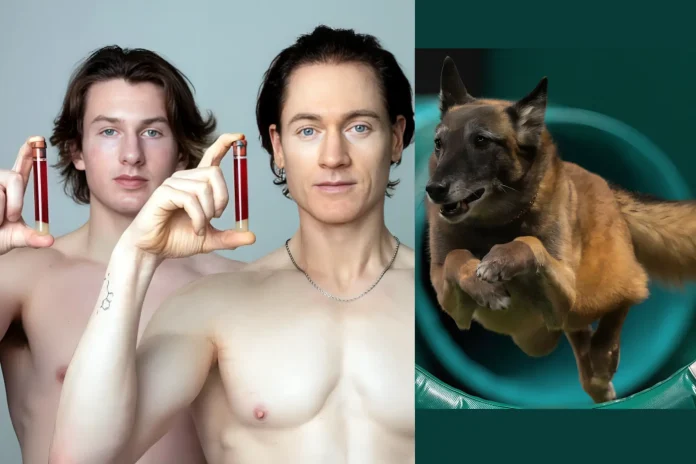
Tech entrepreneur Bryan Johnson, the face of the extreme “Don’t Die” longevity movement, has a new subject for his data-driven anti-aging obsession: his Belgian Malinois guard dog, Katara.
Johnson, who previously received plasma from his teenage son Talmage in a 2023 multi-generational experiment later discontinued after “no benefits detected,” announced in late August 2026 that he acquired the professionally trained protection dog. Katara, approaching her second birthday in October, accompanies him everywhere amid what he describes as “quite a few death threats.” She appeared at his side during a San Francisco longevity event, where Johnson was interviewed by venture capitalist Sarah Guo.
“She’s going to become the most measured dog in the world,”
Johnson said.
“We’re going to do a whole bunch of longevity therapies on her because dogs are amazing.”
He has no plans yet to launch a dedicated canine-health company. Instead, he intends to apply a version of his Blueprint protocol extensive biomarker tracking, customized nutrition, and experimental interventions to her.
https://x.com/HypefreshC/status/2095196366448546061
Johnson highlighted diet as a practical starting point, arguing that most commercial dog foods contain high levels of harmful compounds that “glue your organs together” and are “terrible for their bodies.” He points to biological parallels:
“It’s remarkable how much dogs and humans have in common. When you read through the literature on dogs, and you just replace humans with dogs, there are so many similarities.”
Faster veterinary regulatory pathways could also accelerate learning that informs human aging research, he added.
Katara’s role blends practical security and companionship with science. Johnson has cited observational data linking dog ownership to about a 24% lower risk of early death, drawn from a 2019 meta-analysis of studies involving millions of people. That research, led by Mount Sinai’s Dr. Caroline Kramer, showed an association with reduced all-cause mortality, stronger in some cardiovascular subgroups. Experts stress it remains correlational not proof that owning a dog causes longer life and later re-analyses adjusting for confounders found the link weaker or nonsignificant.
Legitimate canine longevity work already exists. Loyal is advancing LOY-002, a daily pill for senior dogs targeting metabolic aging pathways, with large trials underway and key FDA milestones cleared, though full approval is not guaranteed. Rejuvenate Bio is exploring gene therapies for age-related conditions such as heart disease and osteoarthritis in dogs.
Johnson’s history invites scrutiny. The 2023 plasma exchange with his son was a limited experiment, not ongoing “blood injections,” and the FDA has noted young-donor plasma lacks demonstrated anti-aging benefits for healthy people. His later claim of having “cloned” himself referred to creating induced pluripotent stem cells (iPSCs) established reprogramming technology, not a literal newborn clone or organ bank, scientists clarified.
Applying intensive measurement and unproven therapies to a young working dog raises ethical and welfare questions about animal subjects in personal experimentation. Belgian Malinois typically live 10–14 years with good care; dramatic extension remains experimental.
Johnson’s pivot underscores a broader tension. Can the technology-driven pursuit of longer life usefully extend from humans to our pets and where should the scientific and ethical limits be?

