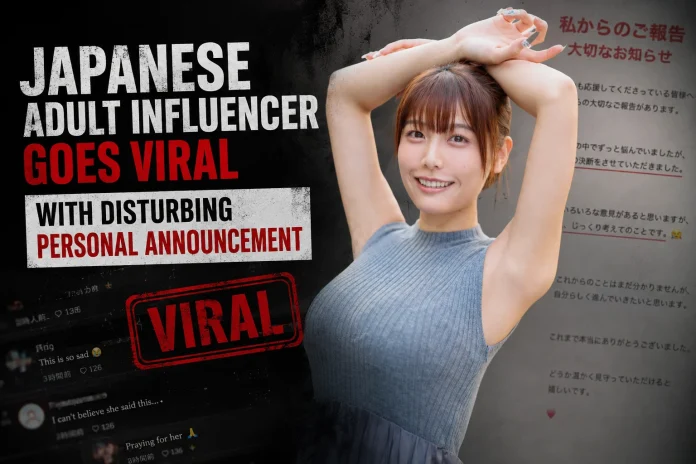
A 27-year-old Tokyo adult content creator who once entered the sex trade to repay her parents the ¥20 million they had spent on her so she could kill herself is now one of Japan’s most-followed independent earners, according to an interview published in the Japanese weekly SPA! on August 29 and picked up in English by RT on August 31. She has told the magazine she no longer plans to die.
The creator, who works under the name Rurutan, told writer Akira Tachibana that she had been a suicidal law student at a Tokyo university when she started working in 2019 at a delivery-health parlor in the Shimbashi district, short roughly ¥30,000 during exam week. By the time she appeared in SPA! she had roughly 1.3 million followers across platforms, a No. 1 ranking on her parlor’s internal board, a photo book, and a self-produced short-video catalog that includes one ¥30,000 clip reportedly generating more than ¥120 million in profit.
“I decided to repay the 20 million yen my parents had spent on me up to that point, and then die,”
Rurutan told Tachibana.
“The work made the ending unnecessary.”
She said the suicidal pressure eased within months as regulars began asking for her by name.
The story has circulated widely because the same person who once answered a help-wanted ad at a Shimbashi brothel-run has become a case study in the emerging Japanese creator economy — work that publishes its own earnings and refuses the conventional adult-video industry on principle. According to a 2026 review of the country’s adult labor market, Japan’s adult industry has shrunk on the talent side, with tens of thousands of women working against roughly seventy men, a female-skewed pool whose economic logic mirrors what Rurutan described privately: repeated income from a small number of loyal clients scales better than chasing a one-time premium.
TokyoReporter covered Rurutan’s disclosure the same day RT did, noting that her career arc tracks a broader 2026 pattern: young Japanese women increasingly renting their own brands on subscription platforms like Fantia and myfans rather than signing with mainstream adult-video producers. Rurutan launched her Fantia account in August 2023 and opened her myfans account roughly a year later, the magazine said.
The financial trajectory is documented. FRIDAY Digital previously profiled her in October 2025, when she was 26 and had just released her first photo book. The English-language sister-publication of Japan’s weekly FRIDAY reported that an early four-minute self-produced clip priced at ¥10,000 had sold about 600 copies, and that her monthly income had hit roughly ¥3 million by the time she raised her rate to ¥40,000 an hour. She is now charging ¥200,000 an hour, according to the magazine. That kind of top-tier trajectory has parallels in the U.S. market: one 21-year-old American OnlyFans creator disclosed $95 million in earnings over two years, a comparable ceiling for the kind of self-publishing that powers Rurutan’s own catalog.
Rurutan told FRIDAY she had entered the industry after what she described as a junior-high sexual assault left her with unstable mental health and a recurring sense that her body carried a price. The salon work, she said, replaced the suicidal urgency with a measurable scoreboard. She held her shop’s No. 1 ranking for 18 months and entered its hall of fame.
The pattern she described has surfaced in other viral-creator suicides in 2026, where the announcement arrives through a published interview rather than a livestream — the analogue of the family-statement pattern seen after other viral-creator suicides this year. Rurutan has framed the eventual book with writer Osamu Suzuki as a practical manual for what Japanese commentators call eros capital — a way of turning physical appeal into steady income without burning the asset in the process.
She told SPA! she still thinks about building support systems for other women in the industry. The framing is the same as it was in 2019, when she first answered the Shimbashi ad: she wanted to repay the debt her parents had taken on for her, then she wanted to die. The plan has not changed. The conclusion has. She is, by her own description, still working toward the same ending — only the distance to it has grown.
The risk in stories like this is reading a personal recovery as an industry verdict. Rurutan’s earnings sit at the extreme of a creator economy that pays almost no one at this level, in Japan or anywhere else. The same platforms that let her clear eight figures in a single clip leave most creators earning under five figures a year. Her case describes what is possible at the top, not what is typical in the middle, and the mental-health trajectory she described — suicidal pressure easing under financial success — is not a road map for anyone else. It is one woman’s account of why she is still alive.