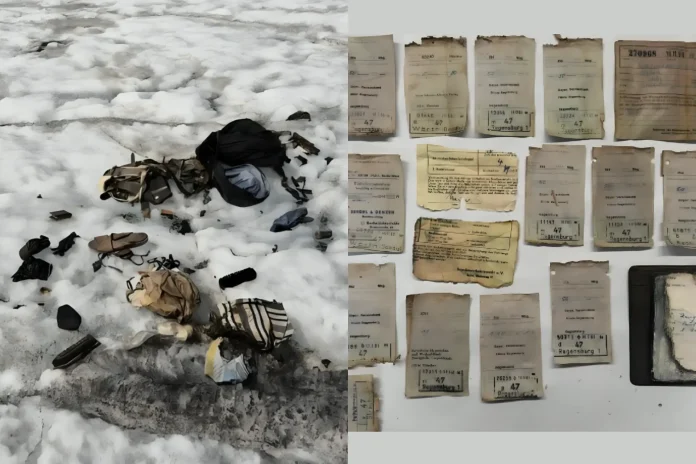
How does a backpack tossed into an Austrian glacier crevasse in 1963 reappear more than six decades later, still holding a vintage camera, ice axe, and pipe? For Alfred Rothfischer, the answer arrived in the summer of 2026.
The Bavarian climber was 23 in early August 1963 when he and two friends completed an ascent of the Schrankogel in Austria’s Stubai Alps. After overnighting at the Amberger Hütte, the rope team set out across the Sulztalferner glacier toward the Dresdner Hütte. Rothfischer, leading, plunged into a crevasse and hung roughly eight meters down. His companions held the rope. Drawing on rescue skills he already knew, he worked Prusik loops to climb out. The heavy pack kept dragging him downward, so he unclipped it and deliberately threw it deeper into the ice to lighten his load. He scrambled free with only minor injuries, later reporting the loss of his documents to police so he could return home to Germany.
The gear stayed buried until mid-July 2026. Mountain guide Marco Span of Neustift, guiding guests across the same glacier at about 2,955 meters (roughly 9,700 feet), spotted a weathered backpack and scattered equipment emerging as the ice retreated. Nearby lay an ice axe, a 1950s- or 1960s-era camera, a pipe (even though Rothfischer was a nonsmoker), a whistle in some accounts, spare clothing, a hat, gloves, several shoe brushes, and a heavily frayed document folder.
The Tyrol Alpine Police took the discovery to be an old accident and attempted to find any remnants, which they did not find. Officer Gregor Gatt dried out the papers delicately. An almost readable name came into view: Alfred Rothfischer. Withdrawal slips from a Bavarian bank led them to Germany. A telephone call was made to Waltraud Rothfischer of Wörth an der Donau, just outside Regensburg. She sat next to her husband, who confirmed immediately that it belonged to him.
Rothfischer, now 86, could not travel because of health problems. On August 25, 2026, a mountain police officer handed the recovered items to his son, Andreas Rothfischer, in Neustift im Stubaital. Andreas later described the torn backpack and scattered contents:
“Ersatzwäsche, die er damals dabeigehabt hat, Mütze, Handschuhe, viele Schuhbürsten, wo niemand weiß, warum er die dabei hatte.”
He added the deeper family meaning: without his father’s survival that day, “Uns gäbe es dann nicht.”
The reunion is striking on its own. It also fits a wider pattern. Retreating Alpine glaciers, driven primarily by human-caused warming, continue to expose objects and traces locked in ice for decades or longer from World War I relics to the famous Ötzi the Iceman. The Sulztalferner itself has thinned and shortened markedly in recent years. Rothfischer’s pack did not simply appear; melting and retreating ice gradually brought it to the surface for a guide to find.
For one Bavarian family, the story that once circulated as family lore now sits on a table at home camera, pipe, axe, and the frayed papers that finally closed a 63-year circle.