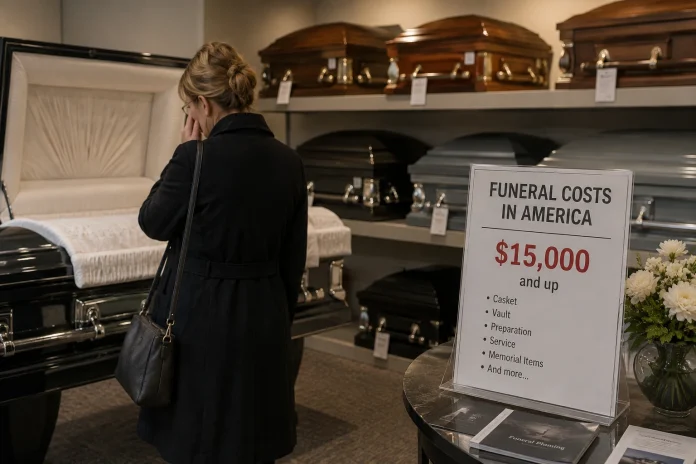
Dying in America has become one of the most expensive final acts a family can face. A traditional funeral and burial now routinely lands between $12,000 and $15,000 once every charge is counted, a total that arrives at the exact moment when people are least prepared to absorb it.
The core numbers come from the National Funeral Directors Association. Its most recent detailed survey put the median cost of a funeral with viewing and burial at $8,300 for the funeral home’s services alone. That figure covers the non-declinable basic services fee, embalming, facilities for viewing and ceremony, a hearse, a mid-range metal casket, and the usual printed materials. Add the burial vault that most cemeteries require and the total edges close to $10,000 before the cemetery itself is even involved.
Cemetery costs then arrive as a separate and often punishing layer. A single plot commonly runs $1,500 to $5,000, though prices in major cities can climb far higher. Opening and closing the grave adds another $1,000 to $2,500. The vault or liner runs $1,000 to $2,000. A headstone or marker starts around $1,000 and easily reaches several thousand more. Put the pieces together and the full traditional send-off regularly settles in the $12,000 to $15,000 range, sometimes higher depending on location and the decisions made under pressure.
Cremation has become the more affordable route for many. The same industry survey listed a median of $6,280 for a funeral with viewing and cremation. Direct cremation without services often falls between $1,500 and $3,000. That difference helps explain why cremation has overtaken burial as the majority choice and continues to rise.
The long climb in prices is clear in the historical record. In 1960 the median cost of an adult funeral with burial stood at $708. By 1980 it had reached about $1,800. In 2000 it was roughly $5,180. By 2021 the figure sat at $7,848 and moved to $8,300 two years later. Adjusted for more recent inflation, estimates for 2026 place the funeral-home portion of a traditional burial near $9,000 or higher before cemetery charges. Over several decades, funeral expenses have risen faster than overall consumer prices.
Costs vary sharply by region. Northeastern states and high-cost coastal metros consistently post the highest figures. Massachusetts, Connecticut, Minnesota and Hawaii rank near the top. Southern and some Mountain West states tend to run lower. Corporate-owned chains, which have expanded through acquisitions, often charge more than independent homes.
The timing of the expense makes everything harder. Families are forced to make these decisions in the days right after a death, frequently without the ability to comparison shop. Many contact only one funeral home. Federal rules require providers to hand over a written price list and to give accurate information over the phone, and they protect the right to buy only the items a family actually wants. In practice, the emotional weight of the moment still limits how many people exercise those rights.
The financial strain shows up quickly. Families turn to credit cards, payment plans, crowdfunding and final-expense insurance after the fact. Some deplete savings or put off other necessities. In lower-income areas the relative burden can be especially severe.
Industry consolidation has played a role. Large operators and private equity firms have steadily acquired independent funeral homes, drawn by steady demand and the coming demographic wave. Critics say the roll-ups reduce local competition and push prices higher. Operators point to rising labor, materials and regulatory costs. Both forces are at work at the same time.
Families who plan ahead or insist on transparency can still reduce the total. Requesting price lists from multiple homes, choosing direct cremation or immediate burial, buying a casket or urn from an outside supplier, and exploring green burial options that skip vaults and embalming can cut thousands from the bill. Veterans may qualify for free burial in national cemeteries plus additional allowances. Pre-need arrangements and modest final-expense policies lock in today’s prices and spare survivors the scramble.
Even so, the central fact remains. For a growing number of American families, a conventional funeral and burial has moved beyond the reach of ordinary savings. The $15,000 figure is no longer an outlier. It is a realistic total that lands while the grief is still fresh.