The biotech industry is abuzz with some exciting news by Moderna and Merck. The two drug companies recently made the announcement that their new personalized mRNA treatment for cancer known as intismeran autogene (or V940 or mRNA-4157) has met its primary objectives during a Phase 3 trial for high-risk melanoma.
The INTerpath-001 study enrolled 1,137 patients with stage IIB–IV melanoma whose tumors had already been surgically removed. Patients got either the experimental vaccine plus Merck’s Keytruda or Keytruda alone. At a planned interim look, the combo significantly improved recurrence-free survival meaning patients went longer without the cancer coming back and distant metastasis-free survival, so the disease was less likely to spread to other parts of the body.
This marks the first positive Phase 3 result for any individualized neoantigen therapy and for an mRNA-based cancer treatment. Shares in Moderna jumped hard on the announcement.
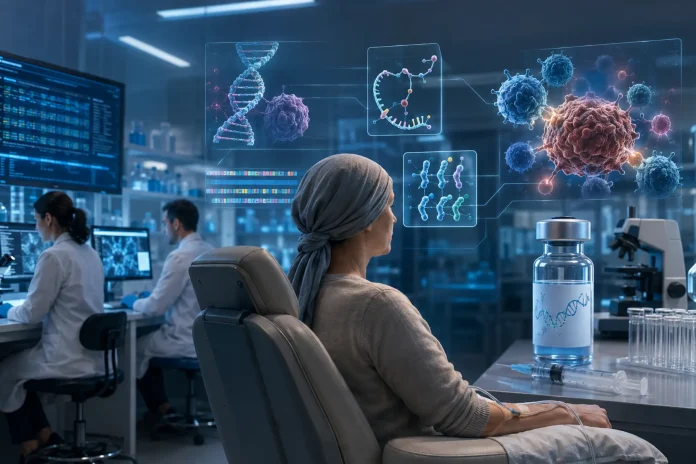
Here’s how the vaccine works in plain terms. Doctors sequence a patient’s tumor to spot unique mutations. Those become neoantigens flags the immune system can target. The mRNA shot is then custom-made to train the patient’s own immune cells against those specific markers, up to 34 per person. It is given after surgery alongside Keytruda as adjuvant therapy, not as a standalone cure or a one-size-fits-all shot for healthy people.
Computational tools, including machine-learning algorithms often called AI, help rank which mutations are most likely to spark a strong immune response. Moderna has described “a series of fully integrated AI algorithms” that process sequencing data and prioritize neoantigens. Nature reporting confirms AI tools assist in selecting the best candidates. This is a real, important step but it is not the whole story. The mRNA platform, manufacturing, clinical testing, and combination with Keytruda follow established biopharma processes. Claiming AI “created” the vaccine or single-handedly drove the Phase 3 win oversimplifies the science.
Principal investigator Georgina Long of Melanoma Institute Australia called the results “a landmark moment for adjuvant melanoma treatment,” noting it is the first Phase 3 study to show the personalized approach plus Keytruda can reduce recurrence risk compared with Keytruda alone. Moderna CEO Stéphane Bancel framed it as proof that mRNA can move beyond infectious disease into cancer care.
Full detailed numbers, including exact risk reductions and longer-term overall survival data, have not been released yet. They are expected at an upcoming medical meeting. Earlier Phase 2 results showed roughly a 49% reduction in risk of recurrence or death and 59% for distant spread at five years, but those figures should not be mixed with the new Phase 3 topline. No new safety signals appeared in the interim analysis.
The treatment remains investigational. It is not FDA-approved. Regulatory filings are planned, and availability if approved would still require careful review of complete data, manufacturing scale-up for truly personalized doses, and questions around cost and access.
This is really a breakthrough for melanoma patients at risk after surgery. It proves that personalized mRNA treatment can actually provide additional value beyond current immunotherapy treatments. However, it is important to note that the complete picture is not yet clear. Both patients and clinicians will carefully monitor the results of this research.