

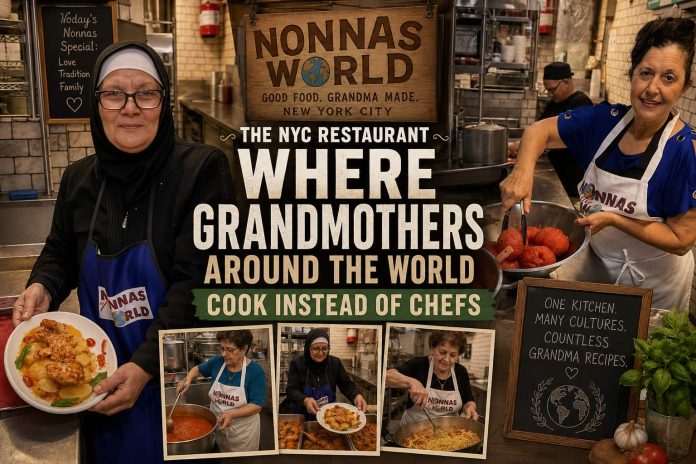
Jody Scaravella never set out to build a restaurant empire. He just wanted his grandmother back in the kitchen.
After losing his mother Maria, his Sicilian nonna Domenica, and several other close family members in quick succession, the former MTA worker took the money he inherited, moved from Brooklyn to Staten Island, and bought a small storefront next to the St. George Theatre. In March 2007 he opened Enoteca Maria with zero industry experience and a simple idea: hire real Italian grandmothers to cook the food they had always made at home.
The early days were rough. The place sat empty on opening night. One of the nonnas got down on her knees and started praying. But the concept stuck. People started coming for the lasagna and stayed for the feeling that someone who actually loved them had cooked it.
Scaravella quickly learned that putting two Italian nonnas in the same kitchen on the same night was a bad idea. “They’re very competitive,” he later admitted. So in 2015 he opened the door wider. The first non-Italian cook was from Pakistan. Then came women from Sri Lanka, Japan, Peru, Greece, Azerbaijan, Egypt, Paraguay and dozens of other places. The only rules: you had to be at least 50, born in the country whose food you were cooking, and good at it. Being an actual grandmother helped, but it wasn’t mandatory.
Nearly twenty years later the restaurant—now operating under the Nonnas of the World Community name and structured as a nonprofit—still runs the same way. Fridays, Saturdays and Sundays only. Four timed seatings. A core of Italian dishes plus whatever the nonna of the day decides to make. The room seats about 35. The vibe is pure family table: steam, conversation, the occasional hug.
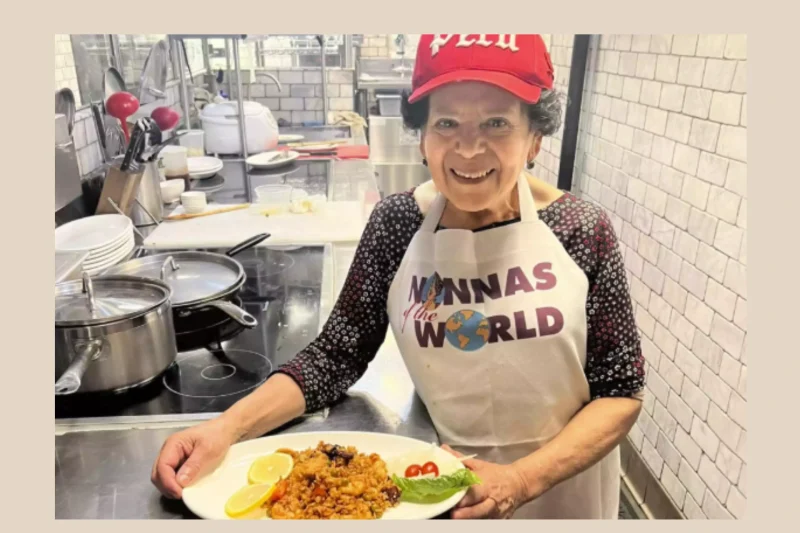
Last year the whole story jumped to a much bigger stage. Netflix’s Nonnas, directed by Stephen Chbosky and starring Vince Vaughn as Scaravella, dropped in May 2025 with Susan Sarandon, Lorraine Bracco, Talia Shire and Brenda Vaccaro playing the nonnas. The film took some dramatic liberties, but the emotional core—grief turned into a kitchen full of grandmothers—was pure Scaravella. The real guy even scored a cameo. The movie hit No. 1 on the streamer and sent a fresh wave of diners scrambling for tables.
Scaravella, now in his early 70s, has always insisted this was never really about running a restaurant. “It’s a project,” he’s said, “and the byproduct is food.” The nonprofit expansion is his attempt to make sure the project outlives him. Grandmothers as teachers. Recipes as cultural memory. A small room on Staten Island that somehow keeps proving the same quiet point: nobody cooks like a nonna.
Reservations remain tough. The ferry ride from Manhattan is still free. And the nonnas keep showing up, carrying the recipes they never wrote down because they never needed to.
