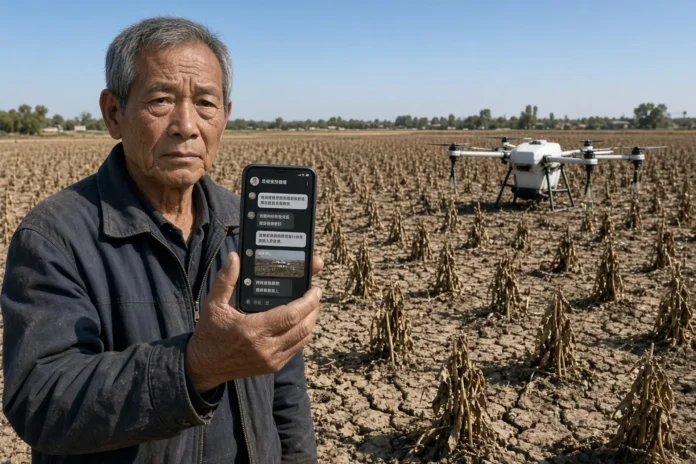
A 67-year-old farmer in China’s Anhui province lost almost an entire season’s sesame crop after taking pesticide recommendations from an AI chatbot, a case that has drawn attention to the risks of relying on general AI tools for specialized agricultural decisions.
Wu, who farms in Chuzhou, had been using the unnamed AI app for more than a year. He started out cautious, testing it on questions about fertilizer timing and basic crop management. The answers proved useful enough that he gradually began treating the tool as a reliable source. On July 10, 2026, he asked the app for a complete weed-and-pest control plan for his sesame seedlings and specifically requested a version designed for drone spraying. The chatbot responded with a detailed recipe that included the herbicides flupyrimethalin and fomesafen, mixed with the insecticides thiamethoxam and emamectin benzoate.
Wu mixed the chemicals as instructed and had a drone spray the full 150 mu—roughly 24.7 acres—without consulting local agricultural experts or running a small test plot first. The next morning the field was gone. Both the weeds and the young sesame plants had wilted and died, with the seedlings dying even faster. “If you spray it, the next day the seedlings won’t survive,” Wu later said. “Both the grass and the seedlings will die, and the seedlings will die even faster.” He estimated the direct loss at about 150,000 yuan, or roughly $21,000 to $22,000.
When he returned to the AI to ask what had gone wrong, the system itself identified fomesafen as the primary cause. Local agricultural technicians and pesticide dealers confirmed the problem. Fomesafen is a broadleaf herbicide primarily registered for soybean fields. Sesame is also a broadleaf crop and highly sensitive to the chemical. Even where the product is approved, it is typically meant for targeted application on weeds only, not full-field broadcast spraying. Applying it across an entire sesame crop by drone left little chance of survival.
The AI interface included a standard disclaimer stating that generated content may be incorrect and should be verified. Wu said he had never noticed the warning during a year of regular use. Representatives for the platform later explained that the system does not maintain its own agricultural knowledge base and instead draws from publicly available online information. They said they would review the sources behind the recommendation and had registered Wu’s complaint, though no details on compensation have been released.
The incident, first reported by Chinese local media and later covered internationally, has fueled discussion about the gap between AI’s confident delivery and the real-world consequences of unverified advice in high-stakes fields. For farmers, doctors, and others making irreversible decisions, the case underscores a simple point: useful answers over time can create a level of trust that removes the usual safeguards exactly when they are needed most.