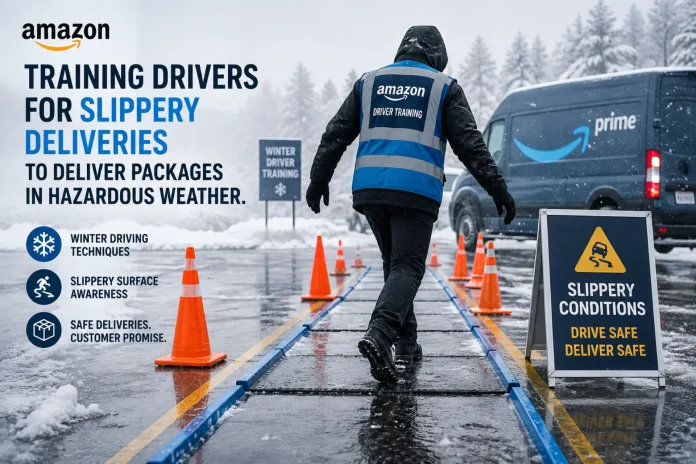
Amazon has expanded specialized training that prepares delivery drivers to navigate ice, snow and other slippery surfaces so packages can still reach customers during hazardous weather.
At facilities across the country, new drivers working for Amazon’s Delivery Service Partners complete sessions at the company’s Integrated Last Mile Driver Academy. One core module is the slip-trip-fall simulator. Trainees strap into a safety harness, step onto a glass surface coated with a soap-and-water mixture that mimics ice or rain, and practice walking while holding a package.
Instructors teach a deliberate marching technique: short steps, shoulders aligned over the hips, eyes kept forward rather than looking down at the ground. Drivers are told that looking down can throw off balance. If a slip begins, they are coached to keep their feet moving. The harness prevents actual falls during the exercise.
According to Amazon’s own reports, more than 140,000 drivers had completed academy training as of October 2025, with the slip simulator among the most frequently cited modules. Company officials state that drivers who finish the course see slip, trip and fall incidents drop by 30 to 50 percent. The academy is projected to operate at more than 95 delivery stations across North America by the end of 2026.
Jessica Murray, a driver trainer at the South Windsor, Connecticut, facility known internally as DEB2, has demonstrated the simulator for local news crews.
“This simulates any kind of icy, any kind of rainy conditions on the road that they may experience while they are delivering any kind of package,”
she said in a December 2025 interview. Trainers there also emphasize proper techniques for exiting delivery vans, showing how using handholds and three points of contact reduces the force on a driver’s body compared with jumping down.
Similar setups operate at other stations. In the Cincinnati area, site leader Kurt Wainscott and trainer Krista Leonard have walked reporters through the same soapy surface. Wainscott tells drivers that if a driveway looks too steep or icy, they should skip it.
“The customer will get their package when they need to. Your life is not replaceable,”
he said. Leonard has noted that the blue booties and textured covers placed over trainees’ shoes make the slickness feel realistic.
The training forms part of a broader winter readiness effort. Amazon equips Delivery Service Partner drivers with ice cleats, scrapers, snow shovels and other gear, as documented in the company’s official winter safety overview. Company meteorologists, including Ty Smith, use predictive forecasting to adjust routes and shift schedules days ahead of storms. Drivers are repeatedly told they may return to the station at any time if conditions feel unsafe.
Related Coverage: Amazon Drone Delivery Dallas Launch: Residents Spark Outcry Over Noise Pollution
Academy sessions typically last two or three days and also cover vehicle inspections, loading techniques, pet encounters and virtual-reality scenarios that simulate road hazards. Larger sites add mock delivery environments and driving simulators. Amazon states that safety remains the priority even as the company moves hundreds of millions of packages through peak winter periods.
Local stations from Massachusetts to Ohio and Pennsylvania have documented the same core drills in recent winters. In Littleton, Massachusetts, and Erie, Pennsylvania, among other locations, the simulator and three-points-of-contact practice appear as standard elements of onboarding for new drivers. Amazon continues to roll the program out to additional markets as winter weather returns each year. For related industry coverage, see Hypefresh’s reporting on the viral Amazon delivery driver who inspired millions online.